1.43 Million-Year-Old Footprints Reveal Social Behavior of Extinct Human Cousin
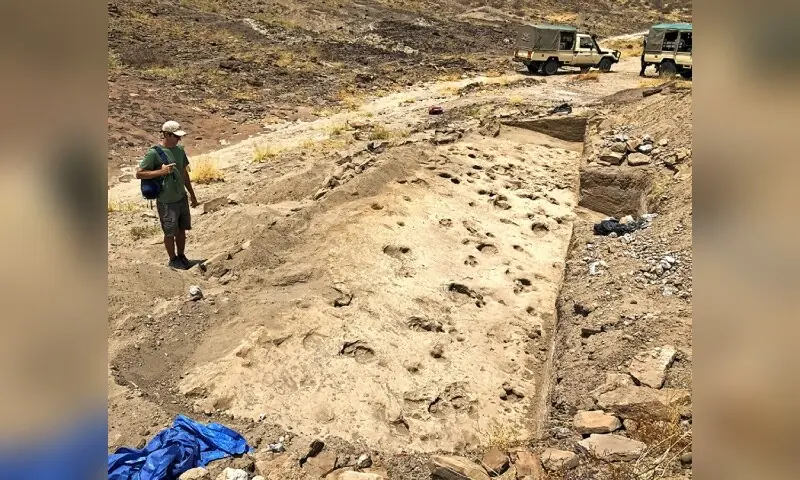
Ancient footprints discovered near Kenya's Lake Turkana are offering new insights into Paranthropus boisei, an extinct hominin species that lived approximately 1.43 million years ago. Researchers identified 21 footprints belonging to eight individuals, suggesting they were walking together on a muddy lakeshore. The tracks were attributed to Paranthropus boisei based on their distinct foot shape and gait, with their size indicating they were likely adult males. This discovery provides a rare glimpse into the social dynamics of this species, suggesting that males sometimes traveled in groups without females or children, potentially forming 'bachelor male groups' similar to those seen in gorillas. Paleoanthropologist Kevin Hatala of Chatham University and the Max Planck Institute for Evolutionary Anthropology, the study's lead author, highlighted that these findings contribute to understanding how these hominins looked, walked, and interacted. The footprints suggest Paranthropus boisei was larger than previously estimated, with an estimated height of up to 6 feet (1.83 meters) and a weight of around 165 pounds (74.84 kilograms), rivaling Homo erectus in size. This challenges earlier assumptions that Paranthropus boisei was smaller in body size compared to the more human-like Homo erectus. The species is known for its robust skulls and large teeth, adapted for eating tough vegetation like grasses and sedges. The footprints were dated using volcanic ash in the surrounding rock. Other animal tracks, including those of hippos and antelope, were also found at the site. Paranthropus boisei, the last of its genus, is believed to have gone extinct around 1.2 million years ago, possibly due to climate change affecting food resources or competition from Homo erectus. The study was published in the journal Proceedings of the National Academy of Sciences.
The discovery of Paranthropus boisei footprints offers a valuable empirical data point for understanding hominin social structures and physical characteristics beyond fossilized skulls and teeth. This evidence suggests a more complex social organization, including male group formations, than previously inferred solely from skeletal remains. The finding that Paranthropus boisei may have achieved body sizes comparable to Homo erectus, despite distinct cranial adaptations for a specialized diet, highlights potential convergent evolution or greater dietary flexibility than assumed. Future research could explore how these physical and behavioral adaptations influenced inter-species competition and survival during periods of environmental change, particularly in the context of the evolving hominin landscape leading up to the dominance of the Homo genus.
AI-generated to prompt reflection — not editorial opinion, not advice, not a statement of fact. How this works.