50 years later, Viking mission's life-on-Mars findings are questioned
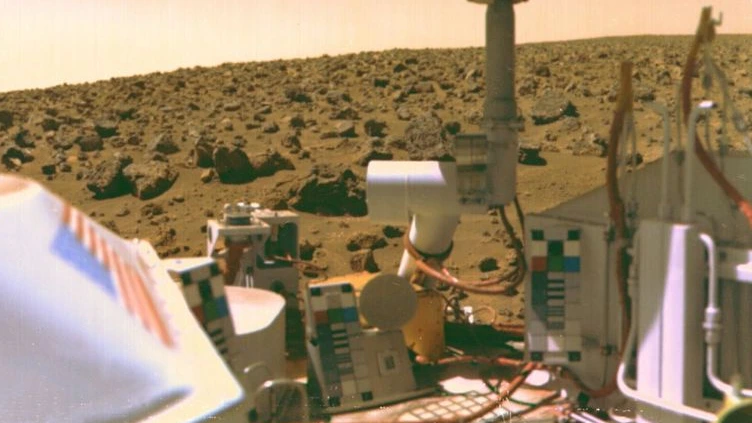
Fifty years ago, on July 20, 1976, NASA's Viking 1 lander touched down on Mars, marking a historic moment with the first images of the Martian surface. The mission's primary goal was to search for signs of life using onboard mini-laboratories. While three experiments detected reactions when water and nutrients were added to Martian soil, these were initially dismissed as non-biological. A key factor in this conclusion was a fourth experiment that failed to find organic molecules, instead detecting chlorocarbons, which were attributed to terrestrial cleaning agents used during the lander's decontamination. However, new insights suggest these findings may have been misinterpreted.
A 2009 discovery by the Phoenix lander revealed the presence of chlorine-containing minerals on Mars. These minerals can react with organic molecules in the Viking instruments to produce the same chlorocarbons observed in 1976. Experiments with a replica of the Viking mini-lab have since confirmed that the original landers might have detected more than initially believed. Astrobiologist Inge Loes ten Kate from Utrecht University suggests that the Viking experiments may have inadvertently killed potential Martian microbes by adding too much water, akin to drowning them.
Subsequent Mars rovers, like Perseverance, have found evidence of organic molecules in Martian rocks, further fueling speculation about past or present life. Ten Kate advocates for a new mission, similar to Viking, to re-examine these findings and definitively search for microbial life, noting that current international 'planetary protection' protocols may hinder such investigations. The European Rosalind Franklin rover, planned for 2030, aims to search for biological molecules and signs of life by drilling up to two meters deep, though the ultimate depth of potential life remains uncertain.
The 50th anniversary of the Viking Mars landings prompts a re-evaluation of early life-detection experiments. While initial conclusions pointed to a sterile Mars, subsequent scientific understanding of Martian geochemistry and potential biological processes suggests that the Viking results may have been misinterpreted. The presence of chlorine-bearing minerals, identified years later, offers a plausible abiotic explanation for the detected chlorocarbons, thereby re-opening the possibility that the positive reactions observed in the Viking experiments could have been biological. This historical scientific debate highlights the challenges of interpreting extraterrestrial data with limited knowledge and technology, emphasizing the need for robust, multi-faceted missions and careful consideration of experimental conditions to avoid premature conclusions. Future missions must balance the imperative to search for life with planetary protection protocols, ensuring that potential biosignatures are not inadvertently destroyed or misinterpreted.
AI-generated to prompt reflection — not editorial opinion, not advice, not a statement of fact. How this works.