Afghanistan-Pakistan Transit Trade Plummets to Historic Low
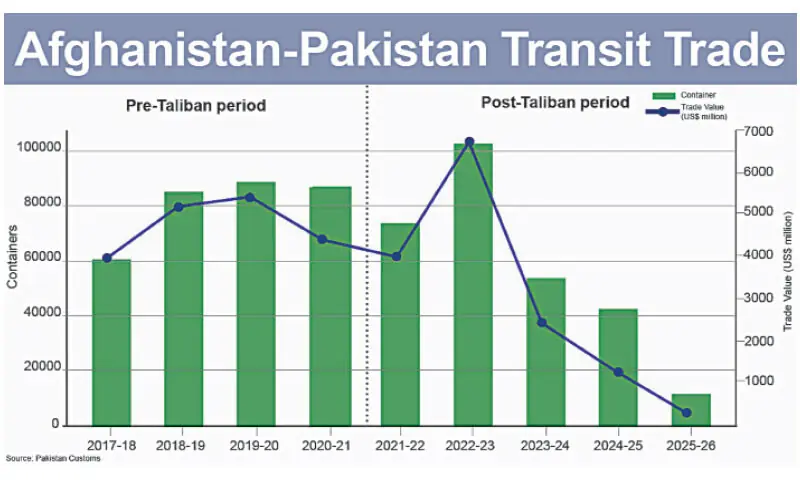
Afghanistan's transit trade with Pakistan has reached a historic low, falling to just 11,592 containers valued at $367 million in the fiscal year 2026. This represents a dramatic decline from nearly 89,000 containers worth $5 billion before the Taliban's return to power. While Pakistan's border closure in October 2025 over security concerns accelerated this downturn, data indicates that Afghanistan had already begun a strategic shift to reduce its dependence on Pakistani routes. Kabul has actively pursued expanding trade through Iran and strengthening commercial ties with Central Asian nations.
Historically, Pakistan served as Afghanistan's primary and most cost-effective gateway to international markets. Transit trade through Pakistan saw steady growth under the previous democratically elected government, increasing from approximately 60,500 containers in FY17 to nearly 89,000 in FY21. Even after the Taliban's takeover, transit cargo initially recovered, peaking at 102,886 containers worth $6.7 billion in FY23, before declining sharply in subsequent years.
The collapse in reverse transit, which facilitates Afghan exports to third countries like India, has been even more severe, plummeting from $454 million in FY25 to a mere $7 million in FY26. Despite securing alternative import routes, primarily through Iran, this shift has imposed significant economic costs on Afghanistan. Imports rose by 15% to $13.2 billion in FY25, with Iran accounting for the largest share of imports and transit corridors. This diversion has led to increased import costs, reduced export opportunities, and inflationary pressures on consumers, disproportionately affecting communities reliant on cross-border commerce and impacting thousands of livelihoods.
The significant decline in Afghanistan-Pakistan transit trade reflects a complex interplay of geopolitical shifts, national economic strategies, and evolving regional trade dynamics. Afghanistan's deliberate policy to diversify its trade routes, particularly towards Iran and Central Asia, signifies a strategic move to enhance its economic sovereignty and reduce reliance on a single transit partner. This diversification, while potentially offering long-term benefits in terms of reduced dependency, has introduced immediate economic challenges, including increased logistics costs and inflationary pressures, as highlighted by the World Bank. The shift underscores a broader trend of regional economic realignments driven by both political considerations and the pursuit of more resilient supply chains in an increasingly volatile global environment. Future trade patterns will likely depend on the sustainability of alternative routes, the resolution of bilateral security concerns, and Afghanistan's capacity to manage the economic transition effectively.
AI-generated to prompt reflection — not editorial opinion, not advice, not a statement of fact. How this works.