AI Achieves Near-Gold Medal Performance at International Math Olympiad
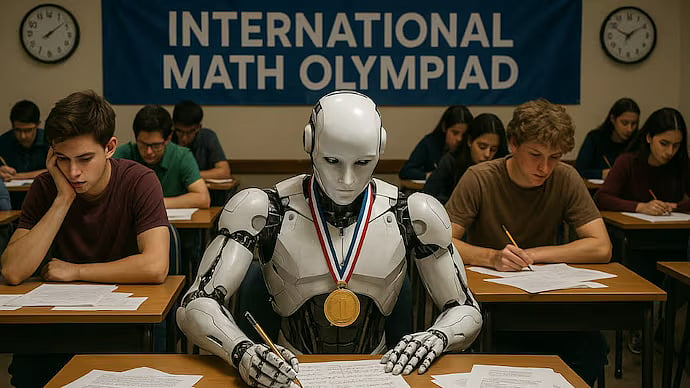
In 2024, Google DeepMind's AI systems, AlphaProof and AlphaGeometry 2, demonstrated remarkable capabilities at the International Mathematical Olympiad (IMO). These AI models successfully solved four out of the six complex problems, achieving a score of 28 out of a possible 42. This score surpassed the 22 points required for a silver medal and was just one point shy of the 29 points needed for a gold medal. Notably, AlphaProof independently solved the competition's most difficult problem (problem 6), a feat accomplished by only five human participants among 609 competitors that year. AlphaGeometry 2, a specialized system, solved the geometry problem (problem 4).
The advanced AI systems operate on a different principle than language models like ChatGPT. Instead of generating text based on patterns, AlphaProof utilizes reinforcement learning and a formal theorem-proving system called Lean. Lean rigorously verifies each logical step in a mathematical proof, catching even minor errors. The AI was trained by formalizing millions of mathematical problems into Lean and then generating billions of formal problems to train the system in complex proof discovery. When presented with an IMO problem, AlphaProof explores numerous proof paths, validating each step with Lean, discarding incorrect paths, and learning from successful proofs.
Progress continued rapidly, with an advanced version of Google's Gemini model in the 2025 IMO solving five out of six problems, reaching gold medal standard within a year. OpenAI also had a system solve five problems. By 2026, general-purpose AI models, without specialized mathematical training, began solving full IMO papers using only three basic tools, with some achieving perfect scores. Claude Fable 5 notably achieved a perfect score of 42 in its first attempt with minimal cost and time. While AI currently requires significant computing power and specialized engineering for each problem, its rapid advancement suggests a future where AI may serve as a collaborator rather than just a competitor for aspiring mathematicians.
The rapid advancement of AI in solving complex mathematical problems, as demonstrated at the IMO, highlights a significant shift in the landscape of intellectual competition. While AI systems like AlphaProof and AlphaGeometry 2 achieve impressive scores, their current reliance on extensive computational resources and specialized training indicates they are not yet exhibiting general mathematical intelligence. The development raises questions about the future role of human intellect in problem-solving disciplines. The emphasis may shift from rote memorization or even basic proof construction to higher-level conceptualization, critical evaluation of AI-generated solutions, and the development of novel mathematical frameworks. This evolution suggests that human mathematicians will likely need to cultivate skills in collaborating with AI, rigorously verifying its outputs, and focusing on areas where human intuition and creativity remain paramount, ensuring that AI becomes a tool for augmenting human potential rather than a replacement.
AI-generated to prompt reflection — not editorial opinion, not advice, not a statement of fact. How this works.