AI Agent Evaluation Needs Broader Scope Beyond Individual Conversations, Experts Say
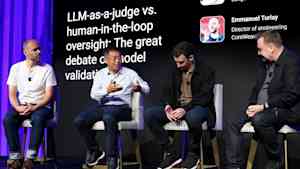
Leaders from LangChain, Conviva, and CoreWeave discussed at VB Transform 2026 that individual AI agent conversations can appear perfect in isolation yet still indicate underlying product flaws. This disconnect is prompting a significant shift in how enterprises assess AI agents, moving from scoring single interactions to comparing user groups against established benchmarks. This evolution is also driving a trend towards utilizing smaller, more specialized AI models for evaluation purposes.
While the default method of using large language models (LLMs) to judge AI agent output, known as LLM-as-judge, remains prevalent, a key challenge lies in balancing scalable automated evaluations with the necessity of human review. Automated systems offer broad coverage but can lack grounding, whereas human review provides depth but is inherently limited in scale. Experts suggest that evaluation criteria are increasingly functioning as product specifications, defining an agent's intended behavior. Teams are advised to launch products and iterate based on real-world performance rather than getting caught in 'evaluation paralysis' with exhaustive pre-launch testing.
Experts highlighted that scoring individual conversation traces is insufficient because it misses crucial signals that emerge only when analyzing user cohorts. For instance, a retail AI agent might appear to perform well in a single interaction, but analyzing the broader user base could reveal a significantly higher clarification ratio or a greater number of abandoned purchases. This 'contrastive analysis' is vital for identifying specific, debuggable issues within product categories. Furthermore, the industry needs to capture data beyond the immediate conversation, encompassing user actions before, during, and after interactions. When selecting evaluation models, the strategy involves starting with highly capable models to prove a task's solvability, then transitioning to smaller, more cost-effective models for ongoing monitoring and specific tasks like binary classification. Even with advanced AI, human oversight remains critical for accountability, legal endorsement, building trust, and facilitating system learning, especially for complex or sensitive applications.
The discussion at VB Transform 2026 highlights a critical inflection point in AI agent development, where the limitations of isolated performance metrics are becoming apparent. The shift from evaluating individual conversation traces to comparative cohort analysis signifies a move towards more robust, real-world validation. This approach acknowledges that system-level behaviors and user experience are emergent properties not fully captured by single-instance scoring. The tension between scalable automated evaluation and indispensable human oversight underscores a fundamental challenge in AI governance: how to ensure safety, reliability, and accountability as AI systems become more autonomous. As AI agents become integrated into critical sectors, the need for clear lines of responsibility and verifiable performance will only intensify, suggesting that human judgment will remain a crucial component, particularly for high-stakes decision-making and trust-building, even as AI's analytical capabilities expand.
AI-generated to prompt reflection — not editorial opinion, not advice, not a statement of fact. How this works.