AI and Brain Implant Restore Movement and Touch to Paralyzed Man
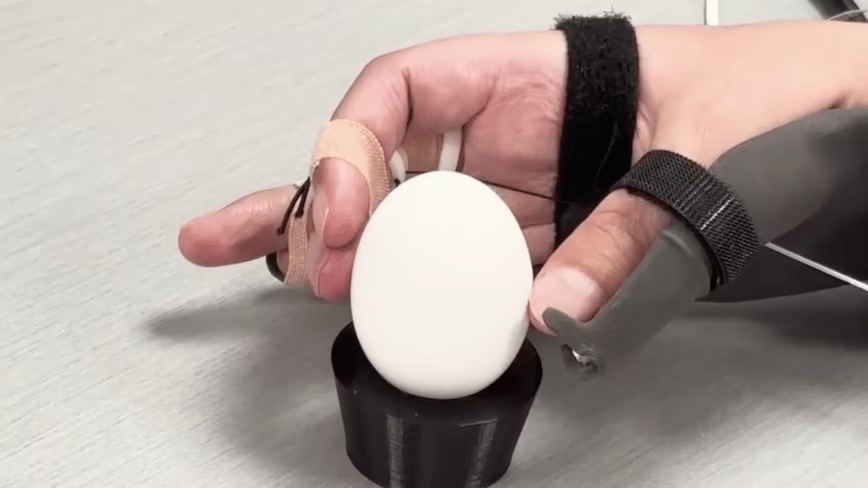
Researchers have successfully restored hand movement and the sense of touch to an individual paralyzed from the chest down. This groundbreaking achievement, detailed in the journal Nature Medicine, indicates that the implemented technology has partially rewired the patient's nervous system. The innovative system, dubbed a "double neural bypass," was developed by the Feinstein Institutes for Medical Research, which is the research division of Northwell Health. This advancement represents a significant step forward in neurotechnology and its potential to overcome severe paralysis. The technology aims to bridge the gap created by spinal cord injuries, allowing for communication between the brain and the limbs. Further details on the specific mechanisms and long-term implications are expected as research progresses. The successful restoration of both motor function and sensory feedback highlights the potential of combining advanced AI with neural interfaces. This could offer new hope for individuals with similar conditions.
This development in neurotechnology demonstrates the potential for advanced AI and neural interfaces to circumvent severe spinal cord injuries. By creating a "double neural bypass," the system facilitates communication between the brain and limbs, restoring both movement and sensation. This approach bypasses the damaged spinal cord, suggesting a pathway for future treatments that could significantly improve the quality of life for individuals with paralysis. The system's ability to partially rewire the nervous system warrants further investigation into its long-term efficacy and adaptability. Future research will likely focus on refining the technology for broader application, exploring ethical considerations, and understanding the full scope of its impact on human motor control and sensory perception in the coming decade.
AI-generated to prompt reflection — not editorial opinion, not advice, not a statement of fact. How this works.