AI Compass: A 15-Question Test to Gauge Your Stance on Artificial Intelligence
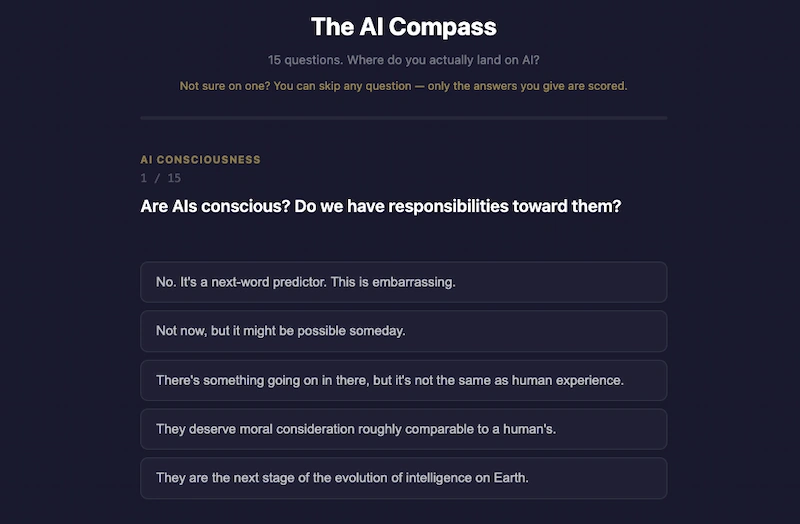
The AI Compass, or 'La brújula de la IA,' is a quick assessment designed to reveal an individual's ideological orientation regarding artificial intelligence. Similar to political or moral compass tests, it poses specific questions that users can skip if they lack an opinion. The test emphasizes that there are no right or wrong answers, valuing each person's perspective. The questions are thoughtfully crafted, moving beyond simple yes/no responses to cover diverse AI topics. These include artificial consciousness, creativity, employment impacts, information integrity, 'slop' and fake news, corporate influence, and existential risks. The assessment also probes user views on AI's application in medicine and education, its regulation, and the feasibility of Artificial General Intelligence (AGI). It asks about who benefits from AI, predictions for 2031, and concerns about the environmental cost of data centers. Responses typically span five or six options, ranging from viewing AI as mere marketing hype to a species-altering force, with many intermediate, pragmatic viewpoints. The results are presented on a graph with two axes: one assessing whether AI is overrated or transformative, and the other evaluating its perceived inherent goodness or badness. This framework generates 30 possible archetypes, each humorously assigned a 'patron saint' like Emily Bender for 'The Luddite' or Ray Kurzweil for 'The Prophet.' The test's strength lies in its nuanced outcomes, avoiding simple pro- or anti-AI labels. Users might emerge as economic skeptics of AI, or as individuals who see AI as negative yet fundamentally transformative. It caters to various user profiles, from free-version enthusiasts and local model operators to security paranoids, investors, and believers in the Singularity. While not a perfect taxonomy, it effectively reflects the current AI landscape.
The AI Compass test offers a structured framework for individuals to articulate their complex perspectives on artificial intelligence, moving beyond simplistic pro- or anti-AI dichotomies. By mapping user responses onto axes of perceived value and transformative potential, it highlights the spectrum of opinions and concerns surrounding AI development and deployment. This approach can help individuals understand their own biases and assumptions, fostering more informed discussions about AI's societal integration. From a systemic perspective, such tools can provide valuable aggregate data on public sentiment, informing policymakers and developers about societal readiness and anxieties. The test's categorization, while informal, reflects underlying tensions in AI discourse, such as the tension between technological optimism and existential caution, or between centralized corporate control and decentralized user empowerment. Understanding these diverse viewpoints is crucial for navigating the ethical and practical challenges of AI's accelerating evolution over the next decade.
AI-generated to prompt reflection — not editorial opinion, not advice, not a statement of fact. How this works.