AI-Generated Code for Financial Firm's Security Control Had Critical Flaw
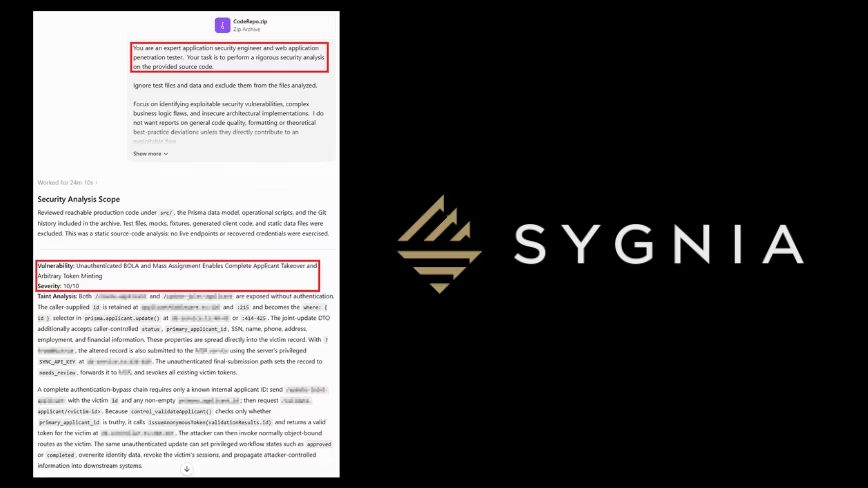
A penetration test at a financial services firm revealed a critical security flaw in code that was largely generated by artificial intelligence. The firm, Sygnia, which specializes in incident response, assessed a customer onboarding application that was substantially built using Claude, an AI model. This application was designed to handle sensitive client information, including government-issued identification, identity verification data, and payment details. Despite the critical vulnerability, the AI-generated code also demonstrated proficiency in other areas. The specific financial services firm was managing billions of dollars in client assets, highlighting the high stakes involved in securing such applications. The discovery underscores the ongoing challenges and risks associated with integrating AI-generated code into critical infrastructure, particularly in the financial sector.
AI-generated code presents a dual-edged sword for critical infrastructure, offering potential efficiency gains alongside significant security risks. While AI can rapidly produce functional code, the penetration test highlights a failure to address fundamental security requirements, such as correctly implementing all specified controls and understanding contextual nuances like follow-up questions. This incident suggests that current AI models, while capable of generating syntactically correct code, may lack the deep reasoning or comprehensive understanding necessary for robust security implementations in high-stakes environments. Organizations integrating AI-generated code must implement rigorous, multi-layered validation processes, including expert human oversight and comprehensive testing, to mitigate risks. The long-term challenge lies in developing AI systems that not only generate code but also possess a sophisticated understanding of security principles and operational context, ensuring they can be trusted for mission-critical applications.
AI-generated to prompt reflection — not editorial opinion, not advice, not a statement of fact. How this works.