AI Identifies Seven Rare Quasars to Study Black Hole Growth
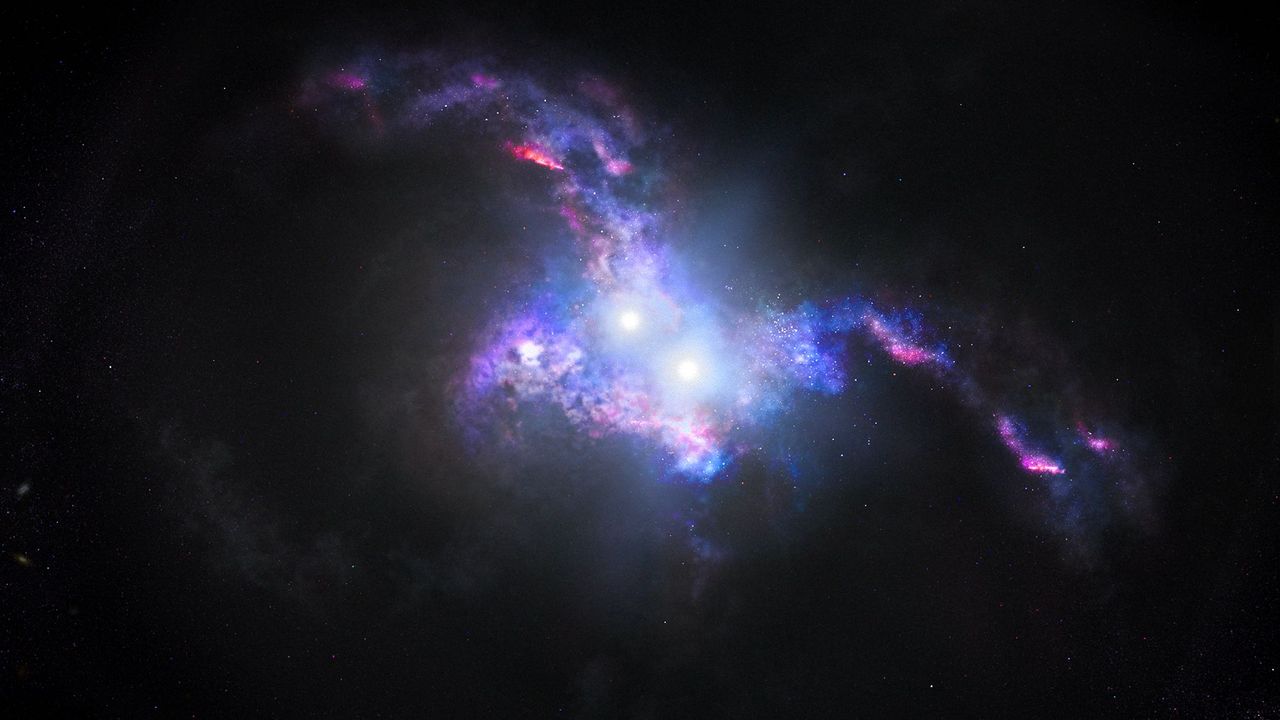
Astronomers have utilized artificial intelligence to identify seven rare quasar gravitational lens candidates. These celestial objects offer a significant new opportunity for scientists to investigate the evolution of supermassive black holes and galaxies. Quasars are extremely luminous active galactic nuclei, powered by matter falling into supermassive black holes at the centers of galaxies. Gravitational lensing occurs when the gravity of a massive object, like a galaxy, bends the light from a more distant object, magnifying and distorting its image. The AI's ability to find these specific candidates suggests a powerful new method for astronomical discovery. By studying these seven quasars, researchers hope to gain deeper insights into the processes that drive the growth of supermassive black holes over cosmic time. This discovery could unlock crucial information about the relationship between black hole mass and galaxy formation. The findings represent a leap forward in using AI for complex astrophysical research.
AI's application in identifying rare astronomical phenomena like quasar gravitational lenses demonstrates a significant advancement in scientific research capabilities. This technology allows for the rapid processing of vast datasets, potentially accelerating discoveries that were previously limited by human observation and analysis speed. The ability to find these specific lensing candidates provides a unique observational pathway to understanding fundamental cosmic processes, such as black hole growth and galaxy evolution. This approach highlights the increasing synergy between computational power and scientific inquiry, enabling researchers to tackle more complex questions about the universe's structure and history. The long-term implications suggest a future where AI-driven discovery becomes a standard tool, potentially reshaping our understanding of astrophysics and cosmology.
AI-generated to prompt reflection — not editorial opinion, not advice, not a statement of fact. How this works.