AI Labs Not 'Pelicanmaxxing,' Study Finds
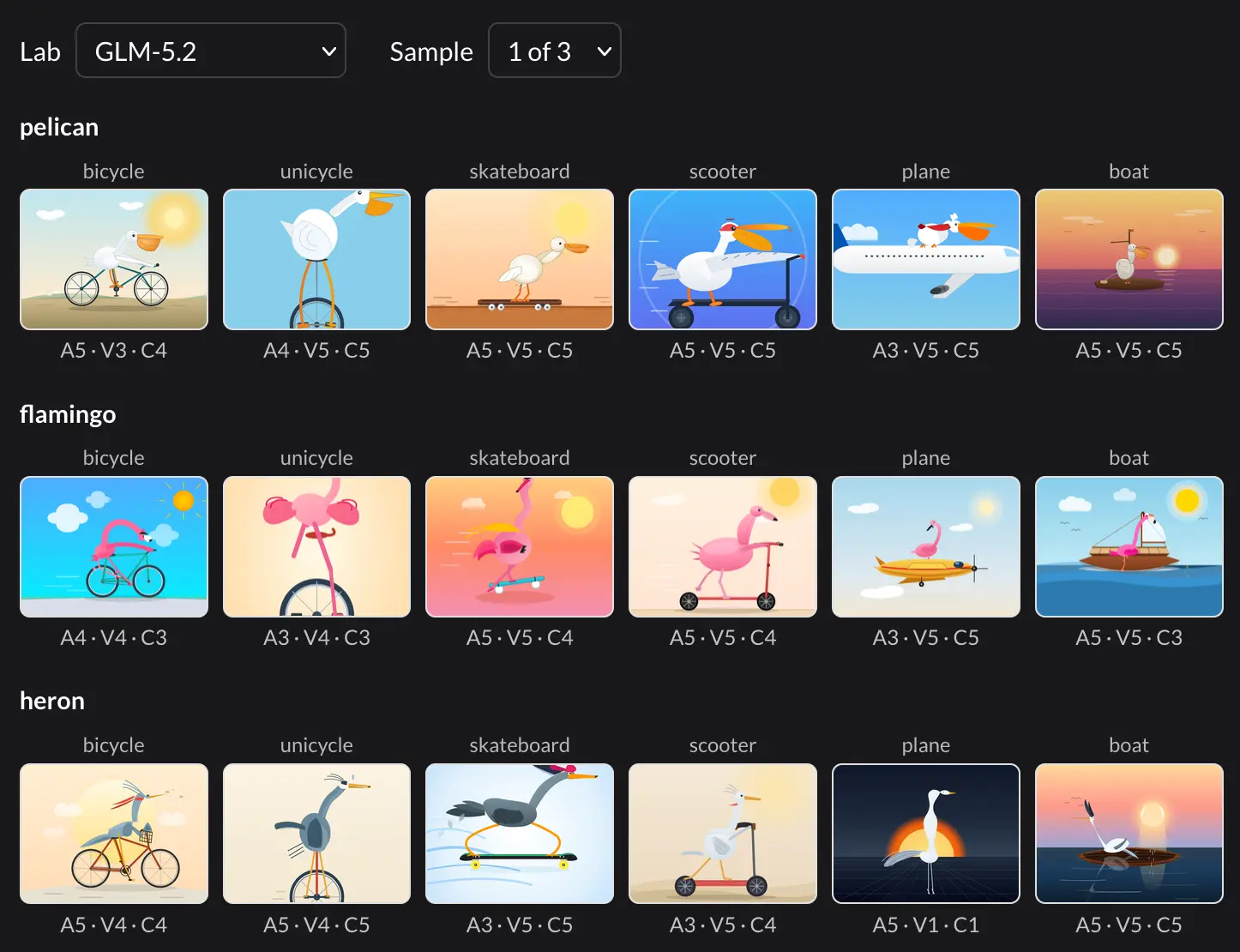
A recent deep-dive investigation by Dylan Castillo has explored the question of whether artificial intelligence labs are deliberately training their models to generate images of pelicans riding bicycles. This phenomenon, termed 'pelicanmaxxing,' was tested using a rigorous methodology. Castillo ran 48 unique prompts, comprising 8 animals and 6 different vehicles, three times each across seven distinct AI models: GPT-5.6 Terra, Claude Sonnet 5, Gemini 3.5 Flash, Grok 4.5, Qwen3.7-Max, GLM-5.2, and DeepSeek V4 Pro. The results were then evaluated using GPT-5.6 Luna and Gemini 3.1 Flash-Lite. The study found no statistically significant evidence to support the 'pelicanmaxxing' theory. Specifically, the models did not demonstrate improved ability to draw pelicans, bicycles, or pelicans on bicycles compared to other animal-vehicle combinations. The generated scenes did not appear memorized, and the quality of pelican and bicycle depictions did not exceed that of other animals and vehicles. While GLM-5.2 showed a slight, non-significant increase in performance on the specific pelican-bicycle prompt, the overall conclusion is that AI labs are not intentionally optimizing for this particular, unusual image generation task.
This investigation into 'pelicanmaxxing' highlights the challenges in definitively proving or disproving specific training biases in large AI models. While the study found no evidence of deliberate optimization for pelicans on bicycles, it underscores the complexity of generative AI outputs. Future AI development may involve more transparent training methodologies and robust evaluation frameworks to understand and control emergent model behaviors. As AI systems become more integrated into creative and informational workflows, the ability to reliably predict and steer their outputs, especially concerning novel or unexpected combinations, will be crucial for maintaining user trust and achieving intended outcomes.
AI-generated to prompt reflection — not editorial opinion, not advice, not a statement of fact. How this works.