AI Model Runs on $10 Microcontroller Using Google's Per-Layer Embeddings
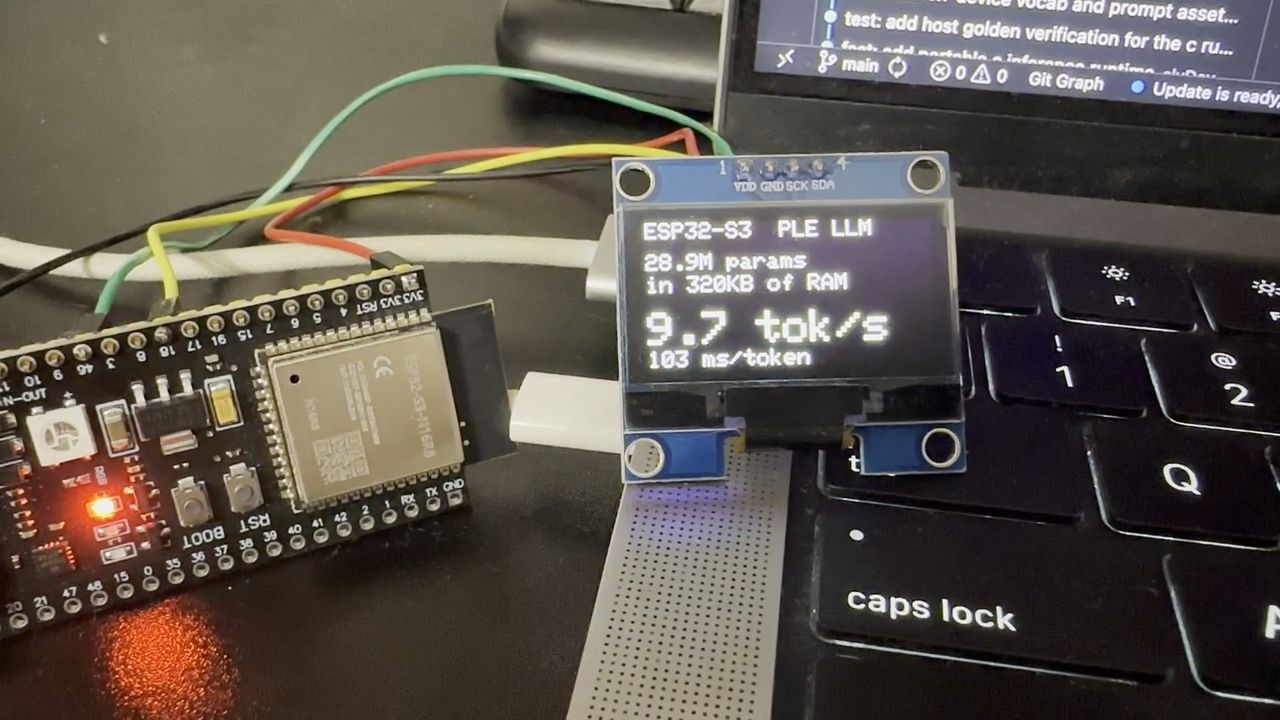
An artificial intelligence developer has successfully implemented a 28.9-million-parameter language model on an ESP32-S3 microcontroller, which costs less than $10. This significant achievement was made possible by utilizing Google's Per-Layer Embeddings technique. The model's associated data table is stored within the microcontroller's 16MB of Flash memory. While the model's capabilities are inherently limited due to the hardware constraints, running such a complex AI on such an inexpensive and low-power device represents a notable advancement in edge AI capabilities. This development opens up possibilities for more sophisticated AI applications to be deployed directly on small, embedded devices without reliance on cloud connectivity. The efficiency gained through techniques like Per-Layer Embeddings is crucial for overcoming the computational and memory limitations of microcontrollers. Further research and development in this area could lead to widespread adoption of local AI processing across various consumer electronics and IoT devices.
This demonstration highlights the accelerating trend of democratizing AI by enabling sophisticated models to operate on resource-constrained hardware. The use of techniques like Per-Layer Embeddings suggests a strategic shift towards optimizing AI for edge deployment, prioritizing efficiency and local processing over raw computational power. This approach could significantly reduce reliance on cloud infrastructure, offering benefits in terms of privacy, latency, and cost, particularly for IoT and embedded systems. The challenge ahead lies in balancing model performance with the inherent limitations of low-power microcontrollers, potentially driving innovation in model compression and efficient inference algorithms. Over the next decade, such advancements may redefine the landscape of AI accessibility, moving powerful AI capabilities from data centers to everyday devices.
AI-generated to prompt reflection — not editorial opinion, not advice, not a statement of fact. How this works.