AI rapidly trains robot dog for complex terrain navigation
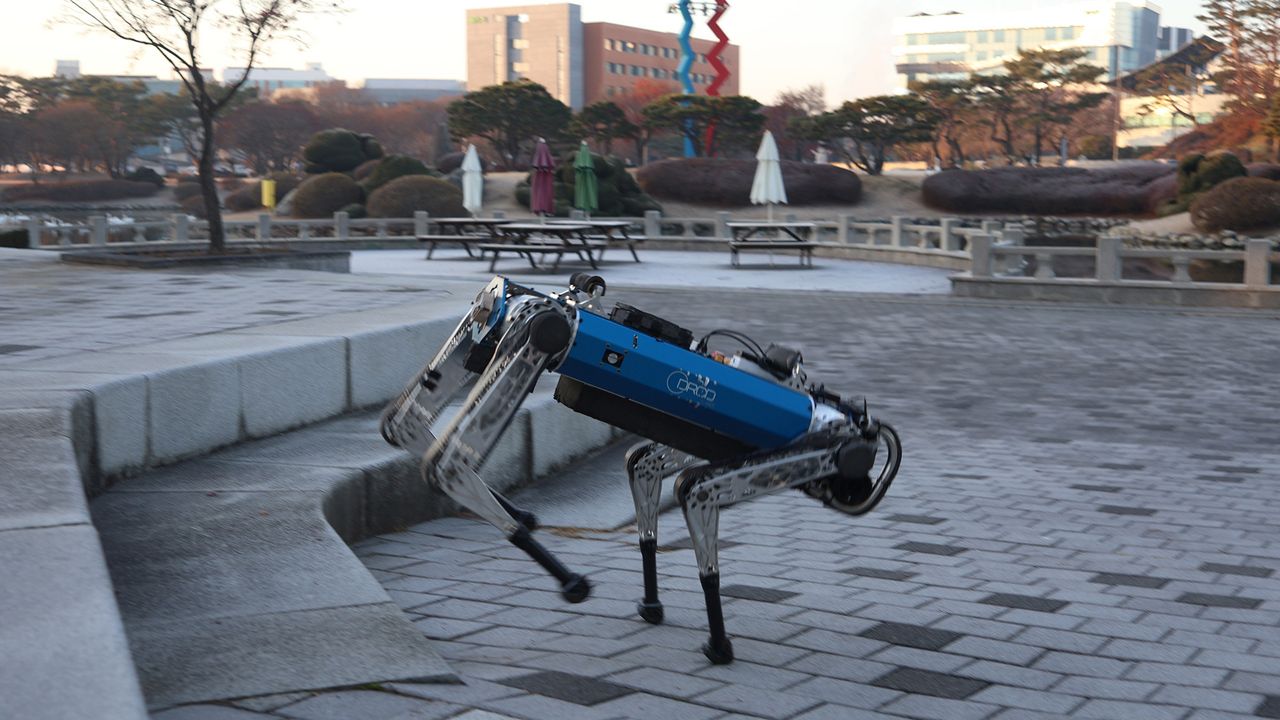
Researchers have developed a novel artificial intelligence training technique that allows a quadrupedal robot, often referred to as a robot dog, to quickly adapt to diverse and challenging environments. The new method utilizes reinforcement learning, a type of machine learning where an AI agent learns to make a sequence of decisions by trying to maximize a reward it receives for its actions. This approach enabled the robot dog to learn how to navigate complex terrains, including climbing stairs, traversing forests, and bounding over obstacles like logs. The training process leveraged two distinct pre-learned gaits, which the robot could then adapt and apply to new situations. This advancement signifies a leap in robotic adaptability and autonomous navigation capabilities, moving beyond static, pre-programmed movements.
This development highlights a significant advancement in the practical application of reinforcement learning for robotic locomotion. By enabling rapid adaptation to varied terrains using pre-learned gaits, the technique addresses a key challenge in robotics: creating systems that can operate effectively outside controlled laboratory settings. The focus on adaptive learning, rather than exhaustive pre-programming, suggests a pathway toward more versatile and resilient robotic platforms. Future iterations may explore how such systems can autonomously discover optimal gaits for entirely novel environments, further reducing human intervention and expanding operational envelopes for robots in fields like search and rescue, exploration, and logistics.
AI-generated to prompt reflection — not editorial opinion, not advice, not a statement of fact. How this works.