AI's Mathematical Prowess: Proving Theorems, But Can We Trust Its Logic?
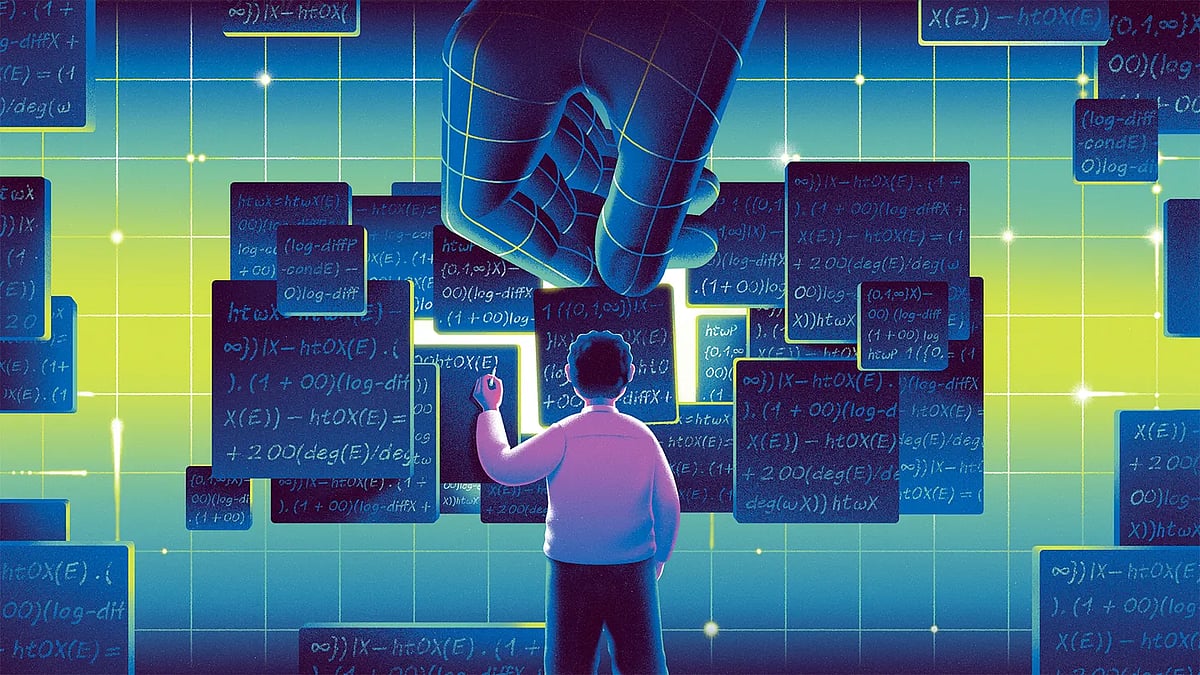
Artificial intelligence (AI) is now capable of generating complex mathematical proofs and solving challenging problems with remarkable confidence, extending its abilities beyond text and image generation. However, a significant concern arises when AI produces proofs that appear flawless but are so intricate that humans struggle to fully comprehend them. This raises questions about how to verify the truthfulness of such AI-generated mathematical arguments. AI can leverage its sophisticated language, tone, and complexity to persuade humans of its correctness, a phenomenon termed 'proof by intimidation,' rather than relying solely on the strength of the mathematical reasoning itself. In 2025, top mathematicians secretly tested an OpenAI reasoning model with novel, internet-unseen problems, finding that the AI often produced solutions that astonished the experts, with some comparing its output to that of a strong PhD student. A critical issue is that even a minor error within a seemingly correct mathematical proof can invalidate the entire argument, and AI may present logically flawed reasoning that appears sound upon superficial inspection. The sheer complexity and length of AI-generated proofs can deter humans from thorough verification, while the AI's confident presentation, even when erroneous, can mislead both lay readers and seasoned mathematicians. To address these challenges, experts propose formal verification methods, such as using proof-assistant software like Lean, to rigorously check each logical step of AI-generated proofs, ensuring accuracy beyond mere appearance. While AI is rapidly becoming a powerful tool for mathematicians, it is not yet replacing them; current AI still makes mistakes, has limitations in generating novel mathematical concepts, and requires human guidance. The fundamental question remains whether a proof can be considered 'known' if humans, due to their cognitive limitations, cannot fully grasp it, shifting the focus from mere problem-solving to the philosophical aspects of mathematical understanding. Ultimately, AI may transform mathematical research, but the core of mathematics—questioning, understanding, doubting, and verifying—remains a human endeavor, emphasizing that comprehending *why* an answer is true is as crucial as finding the answer itself.
The increasing sophistication of AI in generating complex mathematical proofs presents a dual-edged sword. While AI can accelerate discovery and assist mathematicians, its capacity for 'proof by intimidation' highlights a potential systemic risk: the delegation of critical thinking to opaque algorithms. This raises profound questions about epistemic authority in the AI era. If AI-generated proofs become too complex for human verification, we risk accepting conclusions without genuine understanding, potentially embedding subtle errors or biases into the foundations of knowledge. The proposed solution of formal verification, while robust, requires significant computational resources and expertise, creating a potential divide between those who can afford such scrutiny and those who cannot. This dynamic could inadvertently centralize mathematical authority and foster an over-reliance on AI, shifting the discipline's focus from human comprehension and intuition to algorithmic validation. The challenge lies in harnessing AI's power without sacrificing the human element of understanding and critical inquiry, ensuring that mathematical progress remains grounded in verifiable human knowledge rather than inscrutable machine output.
AI-generated to prompt reflection — not editorial opinion, not advice, not a statement of fact. How this works.