Airport Simulator: A Nerve-Testing Game of Guiding Planes
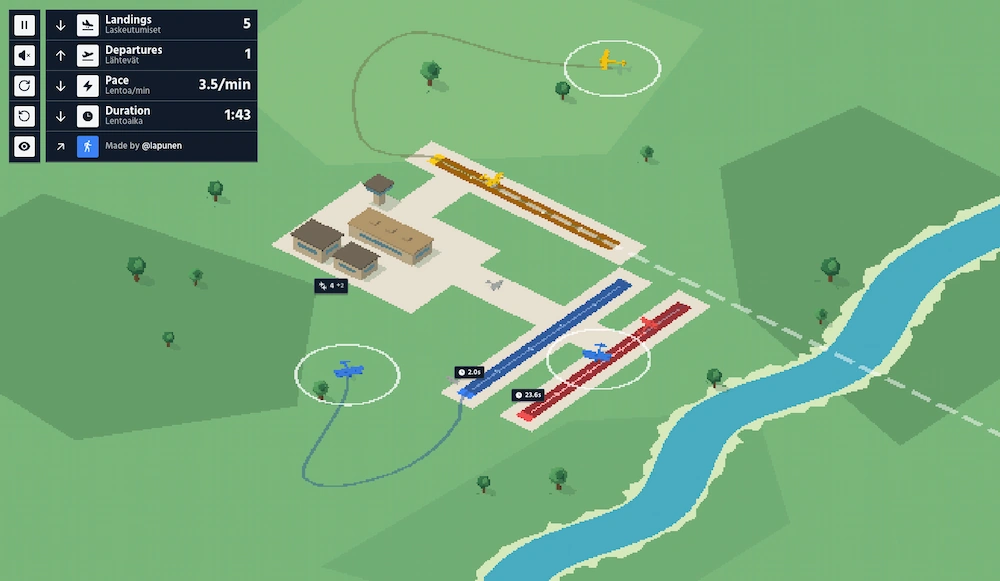
Airport Simulator, a flight simulation game developed by Lisa Apunen, offers a deceptively simple yet challenging experience of managing air traffic. Players guide incoming aircraft by drawing lines to designated landing strips, with the primary objective of preventing mid-air collisions. A key challenge is that all planes inexplicably fly at the same altitude, necessitating careful spacing and trajectory management. Players must also adhere to landing strip directions, indicated by specific markings, and avoid intersecting flight paths, especially when aircraft are close to arriving simultaneously. Minor adjustments to flight curves can help manage these situations. The game features auditory cues, such as 'ding! ding!', to signal successful landings and taxiing to terminals. While takeoff planes are present, they appear in grayscale and do not seem to pose a threat. A control panel displays statistics like the number of planes dispatched, pace, and elapsed time. The ultimate goal is to survive as long as possible, with the difficulty escalating significantly over time. What begins as a calm experience quickly devolves into a complex web of flight paths, often requiring players to constantly avert imminent crashes. The game highlights the intricate demands of air traffic control, a task far more complex than it initially appears. The high score record indicates a player lasted nearly 50 minutes, managing over 600 landings, presenting a significant challenge for aspiring players.
This game simulation effectively translates the complex, high-stakes environment of air traffic control into an accessible digital format. By abstracting the core challenge to trajectory management and collision avoidance, it highlights the critical role of precise decision-making and spatial reasoning. The escalating difficulty and the 'firefighting' nature of later gameplay underscore the inherent systemic pressures and the need for robust predictive capabilities in real-world air traffic management. Future iterations could explore integrating dynamic variables like weather or varying aircraft speeds to further mirror operational complexities, offering players a deeper appreciation for the sophisticated systems and human oversight required to ensure aviation safety.
AI-generated to prompt reflection — not editorial opinion, not advice, not a statement of fact. How this works.