AIUB Hosts Seminar on South Asian Geopolitics in Bangladesh's Context
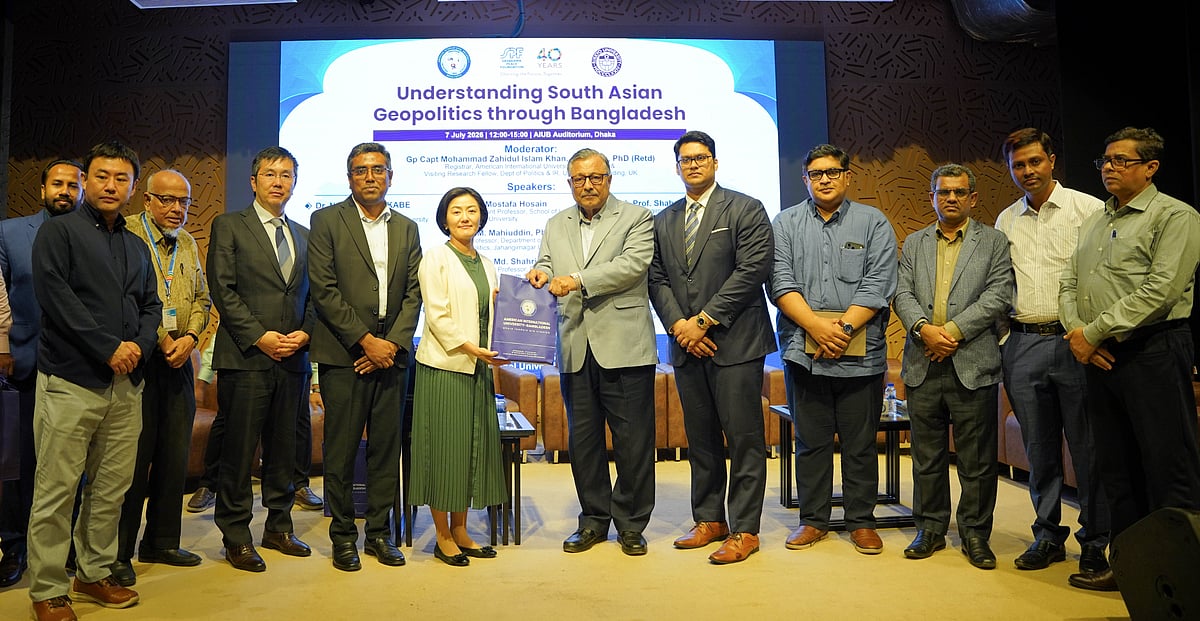
American International University-Bangladesh (AIUB) recently co-hosted an international seminar titled 'Understanding South Asian Geopolitics in the Context of Bangladesh' with Japan's Sasakawa Peace Foundation (SPF) and Rikkyo University. The event, held at the AIUB auditorium on Wednesday, July 8, underscored the institution's commitment to fostering evidence-based discussions and academic dialogue on regional and global affairs. Dr. Naonori Kusakabe, CMS Fellow at SPF and Associate Professor at Rikkyo University, delivered the welcome address, emphasizing intellectual exchange between Bangladesh and Japan and highlighting Bangladesh's growing role in contemporary strategic discussions. Representatives from SPF, including Dr. Akiko Horiba, Dr. Masato Toriya, and Ms. Kiyoka Oimatsu, spoke about Japan's interest in expanding academic cooperation, people-to-people exchanges, and policy-oriented research partnerships with Bangladesh. AIUB Vice-Chancellor Professor Dr. Saiful Islam reiterated the university's dedication to interdisciplinary research, international collaboration, and constructive policy dialogues on critical regional and global issues in his closing remarks. The seminar was moderated by AIUB Registrar Dr. Mohammad Jahidul Islam Khan, who stressed the importance of academic research and intellectual engagement for understanding South Asia's evolving geopolitical landscape. Several academics presented research papers on diverse topics, including economic transformation in South Asia, Bangladesh-Japan relations, China's soft power in Bangladesh, and Japan's engagement in South Asia. The seminar was attended by AIUB's Pro-Vice Chancellor Professor Abdur Rahman, deans, faculty members, and researchers from various universities and policy circles.
This seminar highlights the increasing academic and policy focus on the intricate geopolitical dynamics of South Asia, with Bangladesh situated as a crucial nexus. The collaboration between Bangladeshi and Japanese institutions signifies a growing recognition of the need for diverse perspectives in understanding regional power shifts, economic interdependencies, and strategic alignments. Such dialogues are vital for navigating the complex interplay of national interests, international relations, and the influence of major global powers within the region. The event's structure, featuring presentations on economic transformation, bilateral relations, and soft power strategies, suggests an effort to move beyond traditional security concerns towards a more holistic view of regional stability and development. Future engagements could explore the long-term implications of these geopolitical trends for regional governance and sustainable economic growth in the face of evolving technological and environmental challenges.
AI-generated to prompt reflection — not editorial opinion, not advice, not a statement of fact. How this works.