AMD CTO: Agentic AI Requires Significant CPU Power, Not Just GPUs
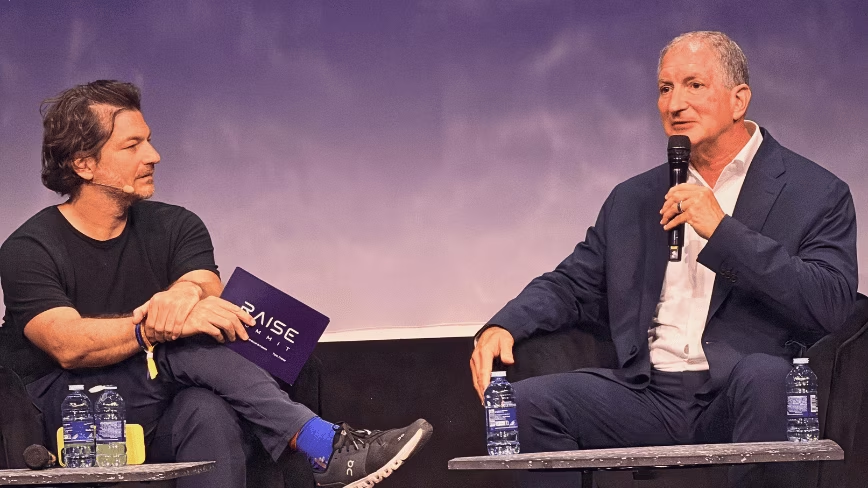
Mark Papermaster, AMD's Chief Technology Officer, stated at the RAISE Summit in Paris that agentic artificial intelligence demands substantial central processing unit (CPU) resources, in addition to graphics processing units (GPUs). This perspective challenges the prevailing notion that GPUs are the sole critical hardware for advanced AI development. Papermaster's remarks suggest a more balanced hardware architecture is necessary for AI systems that can act autonomously and make complex decisions. The discussion occurred amidst AMD's significant market growth, with its stock price rising from around $200 to over $500 in the past six months. This rise indicates AMD's transition from a challenger to a major player in both the CPU and GPU markets, competing directly with established giants like Intel and Nvidia. The emphasis on CPUs highlights a potential bottleneck or a distinct requirement for agentic AI that current GPU-centric approaches may not fully address. Further details on the specific CPU requirements and architectural implications were discussed at the summit.
The evolving demands of agentic AI underscore a critical inflection point in hardware architecture. While GPUs have been central to AI's computational acceleration, the need for robust CPU integration suggests a paradigm shift towards more distributed and specialized processing. This could imply that future AI systems will leverage a synergistic relationship between CPUs and GPUs, optimizing for tasks requiring both parallel processing power and complex sequential logic or control flow. Companies like AMD, positioned across both CPU and GPU markets, may benefit from this trend by offering integrated solutions that cater to these multifaceted AI requirements. Understanding the specific computational trade-offs between CPU and GPU utilization for agentic AI will be crucial for optimizing performance, energy efficiency, and cost-effectiveness in the coming decade.
AI-generated to prompt reflection — not editorial opinion, not advice, not a statement of fact. How this works.