Ancient Greek Cities in Libya
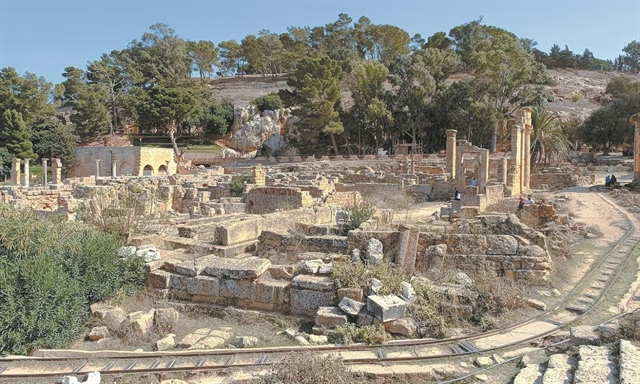
For ancient Greeks, "Libya" encompassed a broader geographical and conceptual area than the modern nation. This region, according to most ancient writers, began west of the Nile Valley. While knowledge of its interior and western boundaries was vague, the coastal zone of present-day Libya was more familiar. Greek settlements and influence extended along this coast, establishing cities that became integral parts of the Hellenistic world. These cities served as crucial points of contact between the Greek and North African civilizations, facilitating trade, cultural exchange, and the spread of Hellenistic culture. The exploration and settlement of these areas reflect the ancient Greeks' drive for expansion and their intricate understanding of the Mediterranean world. The legacy of these Greek cities continues to be a subject of archaeological and historical interest, shedding light on the complex interactions between different cultures in antiquity.
The ancient Greek perception of "Libya" highlights a historical tendency for civilizations to define and project their understanding of geography onto broader, sometimes ill-defined, regions. This expansion of conceptual space, moving beyond precise borders to encompass areas of influence and interaction, is a common theme in historical cartography and cultural expansion. The establishment of Greek cities along the Libyan coast demonstrates the strategic importance of coastal zones for trade and cultural dissemination, a pattern observable across many ancient Mediterranean powers. Examining these historical interactions can offer insights into how geopolitical and cultural boundaries are fluid and subject to interpretation, particularly in eras preceding modern precise mapping and communication.
AI-generated to prompt reflection — not editorial opinion, not advice, not a statement of fact. How this works.