Ancient Rocks Form Coastal Park in São Paulo, Brazil
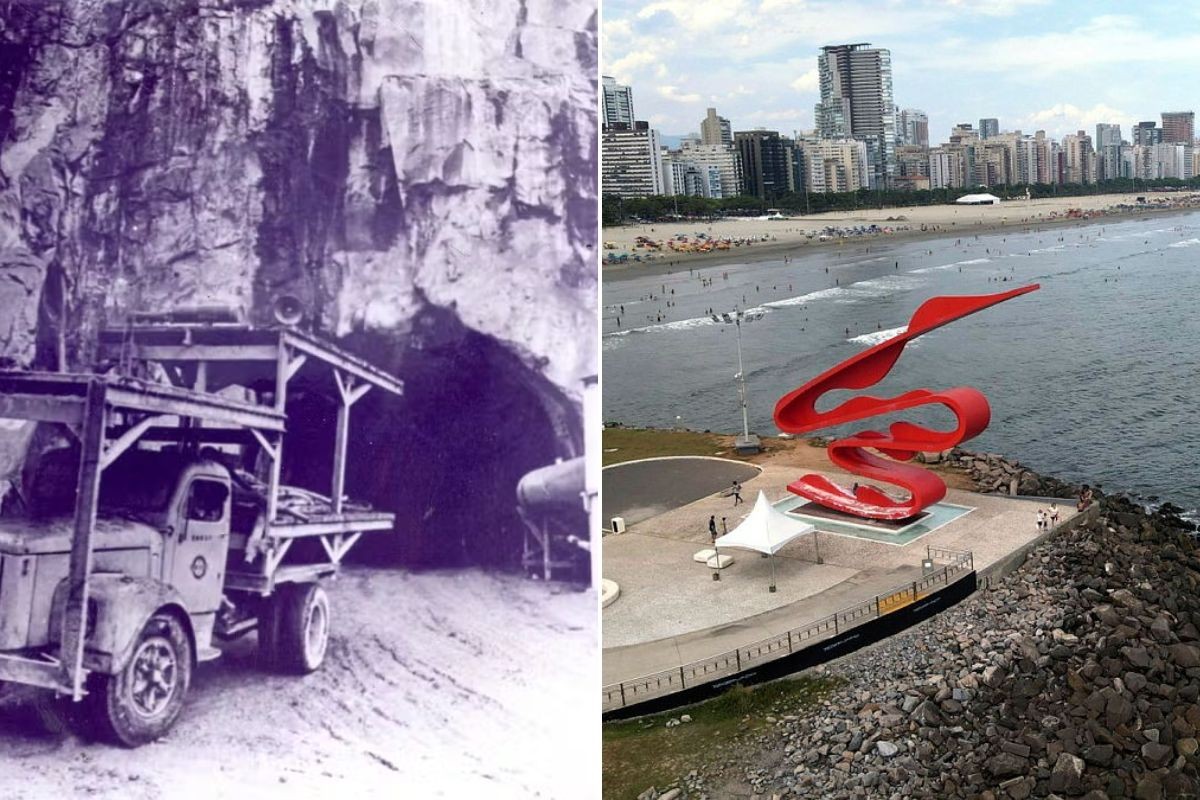
Rocks dating back 600 million years, geologically similar to those found at Rio de Janeiro's Sugarloaf Mountain, have been repurposed to create a marine park in Santos, São Paulo. These ancient granite gneiss stones were excavated during the construction of Latin America's largest tunnel-shaped treated water reservoir, the Santa Tereza-Voturuá Tunnel. The reservoir, with a capacity of 110 million liters, was built within two hills in the Baixada Santista region. The excavated stones were utilized by Sabesp, the São Paulo state water utility, to construct the Santos Submarine Outfall's protective platform, designed to mitigate wave impact on the pipeline. The submarine outfall itself, operational since the 1970s, discharges treated domestic sewage from the Saturnino de Brito Pre-Conditioning Station into the sea, a system expanded due to population growth and tourism. The outfall's pipeline, measuring four kilometers in length and 1.75 meters in diameter, was imported from Italy and employs a diffuser system for effluent release, a technology used internationally. The area where the outfall pipeline originates was transformed into the Municipal Park Roberto Mário Santini in 2010, following Sabesp's transfer of the former construction site to the municipality. Designed by architect Ruy Ohtake, the park features recreational facilities, a skate park, a cycling path, outdoor exercise equipment, and a surf museum showcasing over 70 historical surfboards. The Santa Tereza-Voturuá reservoir, which began construction in 1979 and was completed in 1981, serves Santos and São Vicente and bolsters supply to Guarujá and Praia Grande, playing a strategic role in the region's water security.
This initiative demonstrates a circular economy approach by repurposing excavated geological material from a critical water infrastructure project into a public amenity. The use of 600-million-year-old rocks, comparable to iconic landmarks, adds a unique historical and geological dimension to the coastal park. The project highlights effective inter-agency collaboration between Sabesp and the Santos municipality in transforming a former industrial site into a recreational and cultural hub. From a long-term perspective, integrating such infrastructure with public spaces can foster community engagement and appreciation for both engineering feats and natural heritage. The success of the submarine outfall, a technology employed globally, underscores the importance of robust, scalable solutions for urban sanitation challenges, particularly in densely populated coastal areas facing increasing environmental pressures.
AI-generated to prompt reflection — not editorial opinion, not advice, not a statement of fact. How this works.