Ancient Stellar Flyby May Still Be Altering Comet Orbits
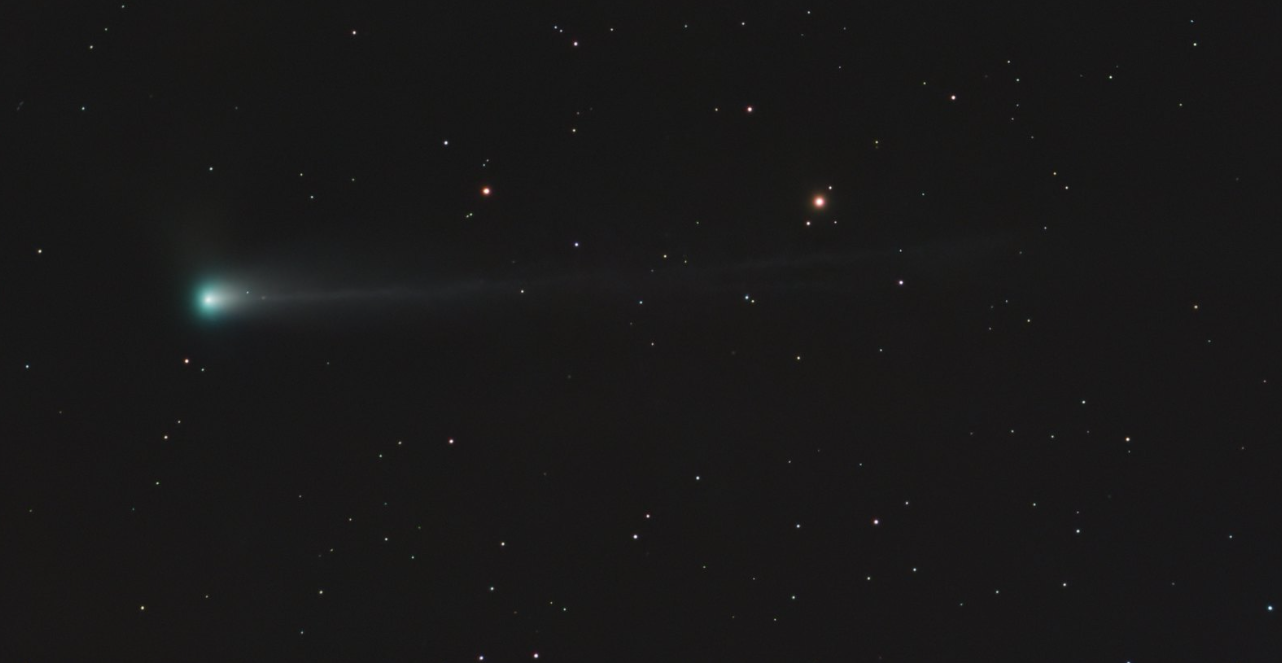
A recent study suggests that the close passage of the star HD 7977, an event occurring in the distant past, may have significantly impacted the orbits of comets observed today. Researchers from the Planetary Science Institute hypothesize that this stellar encounter could have initiated a chain reaction, propelling long-period comets towards the Sun. Furthermore, the study indicates that this increased flux of long-period comets might still be ongoing in the present era. The findings were recently presented at a meeting of the American Astronomical Society's Division on Dynamical Astronomy. This celestial event highlights the long-term gravitational influences that can shape the solar system's dynamics over vast timescales. The study's implications extend to our understanding of the Oort Cloud and the mechanisms that deliver comets from its depths into the inner solar system. It underscores the interconnectedness of stellar systems and the potential for external gravitational perturbations to affect the trajectory of celestial bodies.
This study posits a compelling link between an ancient stellar proximity event and contemporary comet dynamics, suggesting that gravitational interactions across interstellar distances can have enduring effects on our solar system. The research frames a potential mechanism for perturbing the Oort Cloud, a reservoir of comets, thereby influencing the frequency of long-period comets observed. This perspective invites consideration of the solar system's vulnerability to external gravitational influences over cosmic timescales. Understanding such processes is crucial for refining models of cometary delivery and assessing potential impact risks, particularly in the context of future space exploration and planetary defense strategies.
AI-generated to prompt reflection — not editorial opinion, not advice, not a statement of fact. How this works.