Android phones act as early earthquake warning system
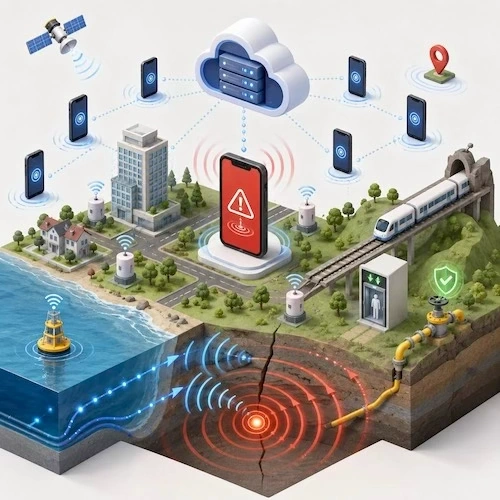
Millions of Android smartphones worldwide are functioning as a distributed network of mini-seismometers, capable of providing early warnings for earthquakes. This system, developed by Google and known as Android Earthquake Alerts, leverages the accelerometer in phones to detect vibrations. When multiple phones in a localized area detect similar patterns consistent with the initial P-waves of an earthquake, they send location data to Google's servers. Google then analyzes this collective data, and if a pattern matches, it issues an alert to users in the predicted impact zone. This technology is not a prediction tool but a rapid detection system offering a few crucial seconds of advance notice. Alerts are triggered for earthquakes of magnitude 4.5 or higher, with two levels: a "Get Prepared" notification that respects silent modes, and an "Act Now!" alert for moderate to strong shaking (magnitude 5+) which overrides silent modes with a loud sound and screen illumination. The "Act Now!" alert provides basic safety instructions. In Venezuela, millions of Android phones reportedly received alerts seconds before two significant earthquakes of magnitudes 7.2 and 7.5 struck, giving some individuals valuable time to take protective actions. While Apple's iPhones can receive emergency alerts, they primarily relay data from official sources and are not as agile as Google's distributed system. The system has demonstrated a low false alert rate, with only 3 false warnings in over 1,200 tests, indicating its statistical reliability. Future applications could include automated responses like stopping elevators, closing gas valves, or slowing trains.
The integration of everyday consumer electronics into critical public safety infrastructure, like earthquake early warning systems, highlights a significant trend of leveraging distributed, crowd-sourced data. While this approach offers remarkable practicality and reach, especially in regions lacking robust official sensor networks, it also introduces considerations regarding data integrity, network dependency, and the potential for information overload or panic if not carefully managed. The system's effectiveness hinges on widespread adoption and consistent device functionality, raising questions about equitable access and reliability across diverse user demographics and device conditions. As such technology evolves, balancing the ingenuity of decentralized systems with the established precision and authority of traditional scientific monitoring will be key to optimizing public safety outcomes in an increasingly interconnected world.
AI-generated to prompt reflection — not editorial opinion, not advice, not a statement of fact. How this works.