Anti-typefaces designed to thwart AI and protect privacy
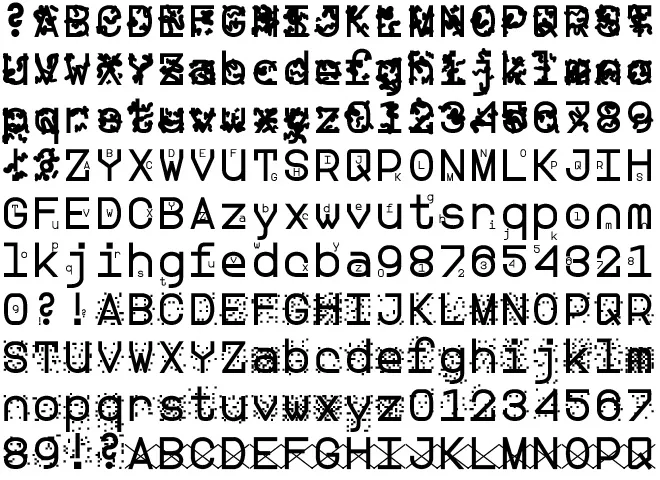
Two innovative "anti-typefaces" are emerging as conceptual tools for enhancing privacy and combating artificial intelligence's ability to process text. The first, ZXX, developed by designer Sang Mun in 2012, aims to confuse Optical Character Recognition (OCR) software. ZXX employs four distinct styles—ZXX Camo, ZXX Noise, ZXX X’ed, and ZXX False—each introducing visual disruptions like smudges, noise, crosses, or false characters to make text difficult for algorithms to interpret, while remaining legible to humans. Although effective against older OCR systems, current advanced AI models like ChatGPT Pro, Claude, and Gemini may overcome some of these challenges. The second concept, Ghost Font, developed by Mixfont, takes a more contemporary approach by encoding messages within the pixel movement of a video, rather than as a static font file. This method creates an illusion that is decipherable by the human eye but difficult for AI to process without access to the source code. Ghost Font also incorporates a decoy message to further mislead AI models. While not practical for document layout, this technique is suitable for applications like video captions, CAPTCHAs, or cover art. The static image of Ghost Font reveals no discernible text, relying on human visual perception to decode the message. The creators suggest that while powerful AI with source code access might decipher it, the effort may not be worthwhile.
These anti-typefaces represent an intriguing intersection of design, privacy, and the rapidly evolving capabilities of AI. While ZXX's approach of visually disrupting text for OCR is a clever tactic, its efficacy is challenged by the continuous advancement of AI, particularly in natural language processing and image recognition. Ghost Font's method of embedding information in dynamic visual illusions highlights a potential avenue for human-AI communication that prioritizes human interpretation. However, the reliance on human visual perception and the potential for sophisticated AI to eventually decode such methods suggest an ongoing arms race. As AI systems become more adept at interpreting complex data, the long-term viability of such 'human-only' text formats may depend on their ability to adapt to AI's increasing sophistication, or perhaps, on a broader societal discussion about the acceptable boundaries of AI's text-processing capabilities.
AI-generated to prompt reflection — not editorial opinion, not advice, not a statement of fact. How this works.