Aqua Regia: The 'Royal Water' That Dissolves Gold
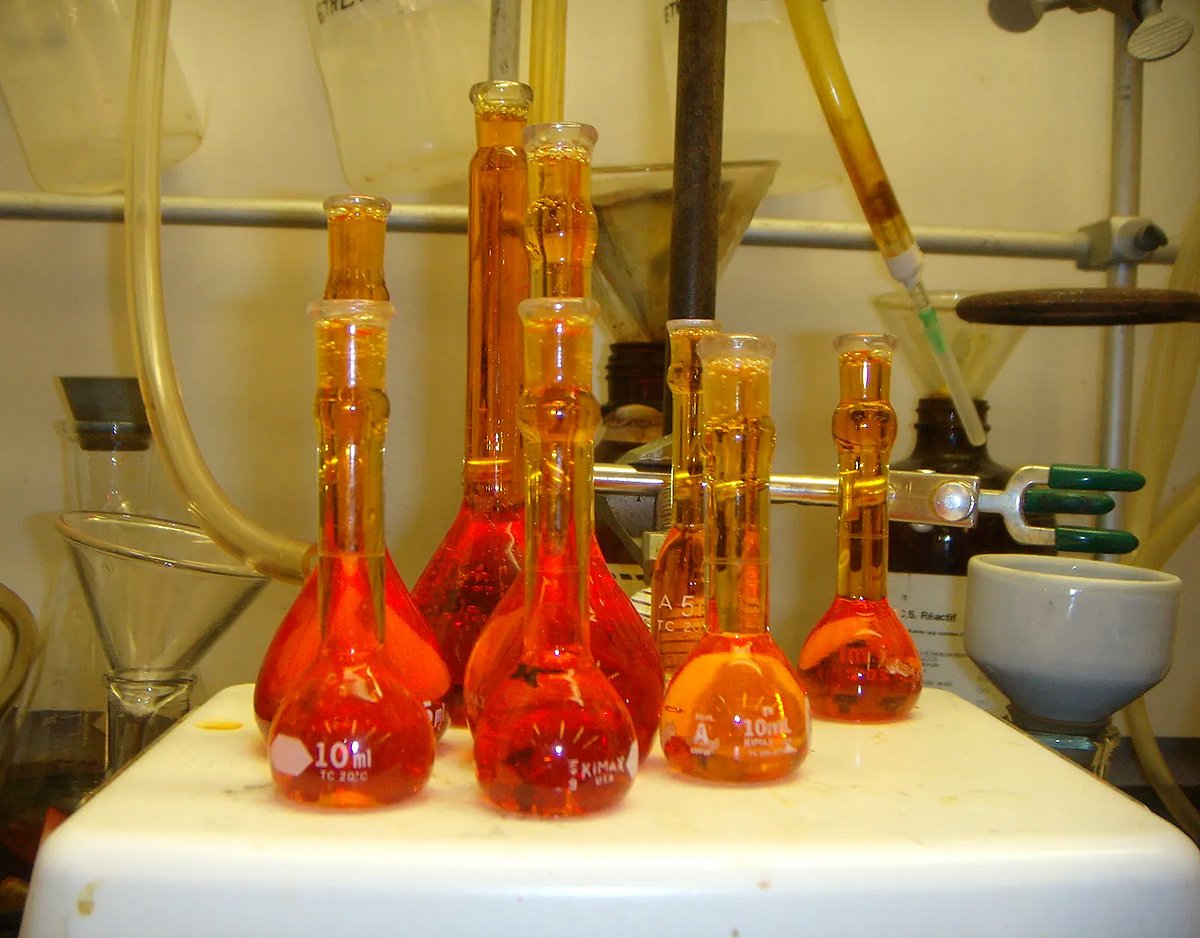
Gold, a symbol of wealth and power for millennia, is renowned for its inertness, resisting degradation from heat, air, water, and most chemicals. Unlike other metals like iron, copper, or silver, gold retains its luster even after thousands of years underground or underwater. Historically, chemists believed no ordinary acid could dissolve gold, with even strong sulfuric, hydrochloric, or nitric acids proving ineffective. Gold's noble metal status signifies its resistance to chemical reactions. However, a remarkable liquid, Aqua Regia, Latin for 'royal water' or 'king's acid,' was discovered to overcome this inertness. This discovery dates back to the 8th century in Kufa, Iraq, by the alchemist Jabir ibn Hayyan, often called the father of Arab chemistry. Driven by the alchemical pursuit of transforming base metals into gold, Jabir experimented with various liquids. He discovered concentrated nitric and hydrochloric acids and, intrigued by their individual strengths, decided to mix them in a 1:3 ratio. The resulting mixture produced a pungent odor and a yellowish-orange hue. When Jabir dropped a piece of solid gold into this solution, it dissolved rapidly, astonishing him. He initially named it 'ma al-dhahab' (water of gold) and later renamed it 'al-ma al-malaki' (royal water), which was eventually translated into Latin as Aqua Regia. This potent combination works through a synergistic 'teamwork' mechanism. Nitric acid initiates the process by oxidizing gold atoms, partially weakening them. However, this creates a protective layer on the gold. Hydrochloric acid then intervenes, with its chloride ions surrounding the weakened gold ions and forming a soluble complex, tetrachloroaurate. This complex dissolves in water, forming chloroauric acid and effectively breaking down the gold's structure. This process continuously removes the protective layer, allowing the acids to dissolve more gold. Aqua Regia must be prepared fresh as it is unstable and degrades within hours, losing its potency. During World War II, Danish chemist George de Hevesy dissolved two Nobel Prize gold medals, belonging to Max von Laue and James Franck, in Aqua Regia to prevent them from being confiscated by Nazi Germany.
The narrative highlights gold's enduring appeal and its chemical resistance, contrasting it with the discovery of Aqua Regia, a solution capable of dissolving this 'noble metal.' The historical account of Jabir ibn Hayyan's discovery frames it as a serendipitous outcome of alchemical experimentation, driven by the desire to transmute metals. The explanation of Aqua Regia's efficacy emphasizes a chemical 'teamwork' between nitric and hydrochloric acids, illustrating how synergistic interactions can overcome individual limitations. This principle of emergent properties through combination is a fundamental concept in chemistry and systems thinking. The article also touches upon the practical challenges of Aqua Regia's instability, necessitating its fresh preparation, and its historical use in safeguarding valuable items during times of conflict. The story serves as a reminder that even seemingly immutable properties can be overcome through novel chemical combinations, prompting reflection on the continuous evolution of scientific understanding and its practical applications.
AI-generated to prompt reflection — not editorial opinion, not advice, not a statement of fact. How this works.