Argentina's 'Maldito Hecho' in Classic Rivalry: A Flag and a Football Match
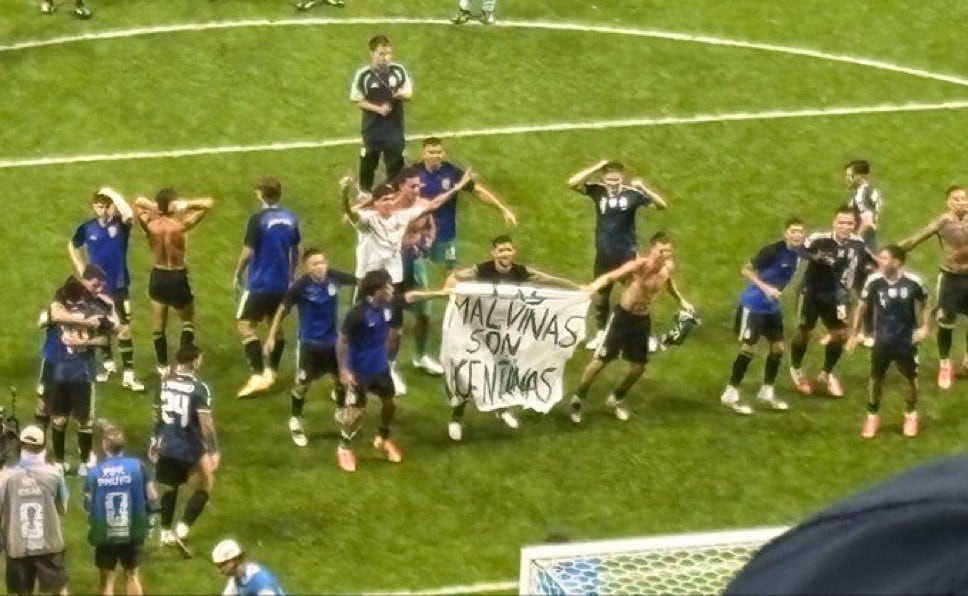
The article reflects on the enduring rivalry between Argentina and England, drawing parallels between a 1986 football match and a recent event during the 2026 World Cup. It begins by referencing the band Sumo's 1986 album 'Llegando los monos,' noting how their song 'Yo quiero a mi bandera' captured a post-dictatorship sentiment in Argentina that distanced itself from nationalistic rock symbolism. This is contrasted with the band Don Cornelio y La Zona, who dared to place a flag on their album cover. The narrative then shifts to the 2026 World Cup, where journalists and players anticipated a final between France and Spain, but Argentina's victory over England was also deemed an 'anticipated final.' The author recounts attending a screening of 'El Partido,' a documentary about the 1986 Argentina-England match, and being moved to tears. This experience was unexpectedly followed by a real-life 'bonus track' just hours later. Unlike the 1986 game's 'Hand of God' or 'cosmic kite' moments, this encounter featured an epic comeback and the subjugation of England, a rival with historical significance dating back to the 1960s and earlier disputes over 'possession' between British railway workers' clubs and local teams. The 'maldito hecho' (cursed event) of this rematch emerged from the stands: a white sheet, smuggled past security, unfurled behind the English goal with the message 'Las Malvinas son argentinas.' This slogan, which had been cautioned against, reappeared as Argentina eliminated England once again, forty years after the 1986 victory. Midfielder Lo Celso, who had played a tribute match, became the focus for displaying the banner, prompting global curiosity. The 'Malvinas sans' typography, inspired by this raw message, evolved into a full alphabet. The 1986 epic, marked by a disallowed goal, has now been paralleled by this rustic flag, making it difficult to determine which event is more 'El Partido.' Both instances represent Argentine transgressions against the same rival: a handball goal and an unauthorized banner. While potential sanctions were discussed, the country known for its complex social dynamics, producing artists like Luca Prodan, became a subject of debate among various societal groups. The Sumo song's lyric, 'Y que me pisen,' seems to resonate, suggesting that transgressing the rules was ultimately worthwhile in both 'El Partido' instances.
The narrative intertwines historical football matches with cultural and political commentary, framing the Argentina-England rivalry as a recurring site of national identity assertion. The unauthorized display of the 'Las Malvinas son argentinas' banner during the 2026 World Cup, mirroring the symbolic transgressions of the 1986 match, highlights a persistent tension between sporting regulations and nationalistic expression. This event underscores how geopolitical disputes can be amplified and reinterpreted through cultural platforms like football. The analysis suggests that such incidents, while potentially leading to sanctions, also serve as potent, albeit controversial, vehicles for national sentiment, reflecting Argentina's complex social fabric and its historical engagement with symbols of sovereignty.
AI-generated to prompt reflection — not editorial opinion, not advice, not a statement of fact. How this works.