Argentine President Criticizes Messi's Team Again, Displays 'Falklands Are Argentina' Banner
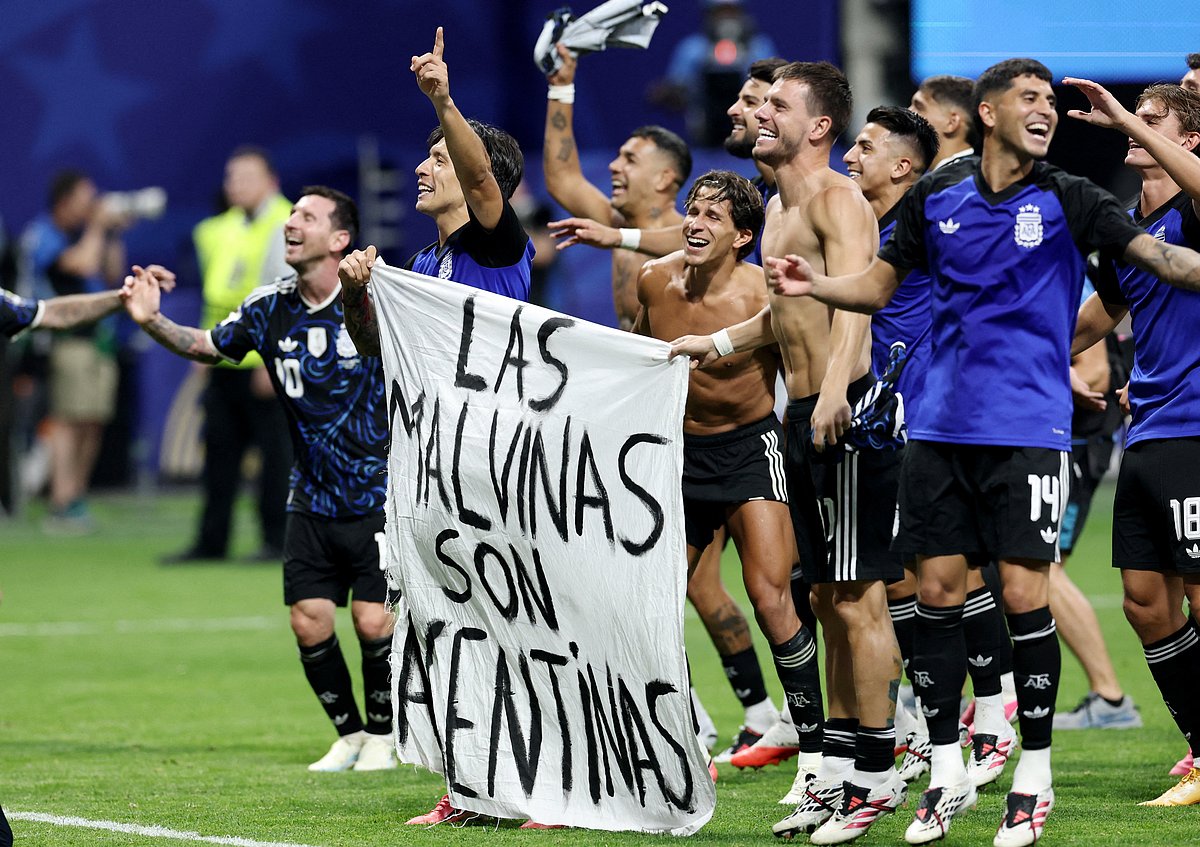
The President of Argentina has once again criticized the national football team, led by Lionel Messi. During a period of celebration following their 2-1 semi-final victory over England, the president displayed a banner stating 'The Falklands are Argentina.' This action brings renewed attention to the ongoing territorial dispute over the Falkland Islands, also known as the Malvinas Islands, between Argentina and the United Kingdom. The football team's success has been intertwined with nationalistic sentiments, as highlighted by the president's public display. The semi-final win marked a significant achievement for the Argentine squad, propelling them further in the competition. However, the president's political statement during this sporting event has overshadowed the team's on-field accomplishments for some observers. The controversy surrounding the Falklands is a long-standing issue with deep historical and political roots. The president's use of the football team's celebration as a platform for this message underscores the potent connection between sports and national identity in Argentina. The team's performance continues to be a focal point for national pride, while also serving as a stage for political expression.
The Argentine President's use of the national football team's victory celebration to display a political banner regarding the Falkland Islands injects a complex geopolitical dimension into a sporting event. This tactic leverages the widespread public enthusiasm for the team's success to amplify a nationalistic political message. Such actions highlight the potent intersection of sports, national identity, and territorial claims. From a systems perspective, this strategy aims to galvanize domestic support by linking athletic achievement with historical grievances and national aspirations. However, it also risks international diplomatic friction and may distract from the purely sporting achievements that unite the populace. The long-term impact could be a further politicization of national sporting moments, potentially creating divisions rather than fostering universal celebration.
AI-generated to prompt reflection — not editorial opinion, not advice, not a statement of fact. How this works.