Astronomers Discover Most Distant Quasar Ever Seen, Shining Brighter Than a Trillion Suns
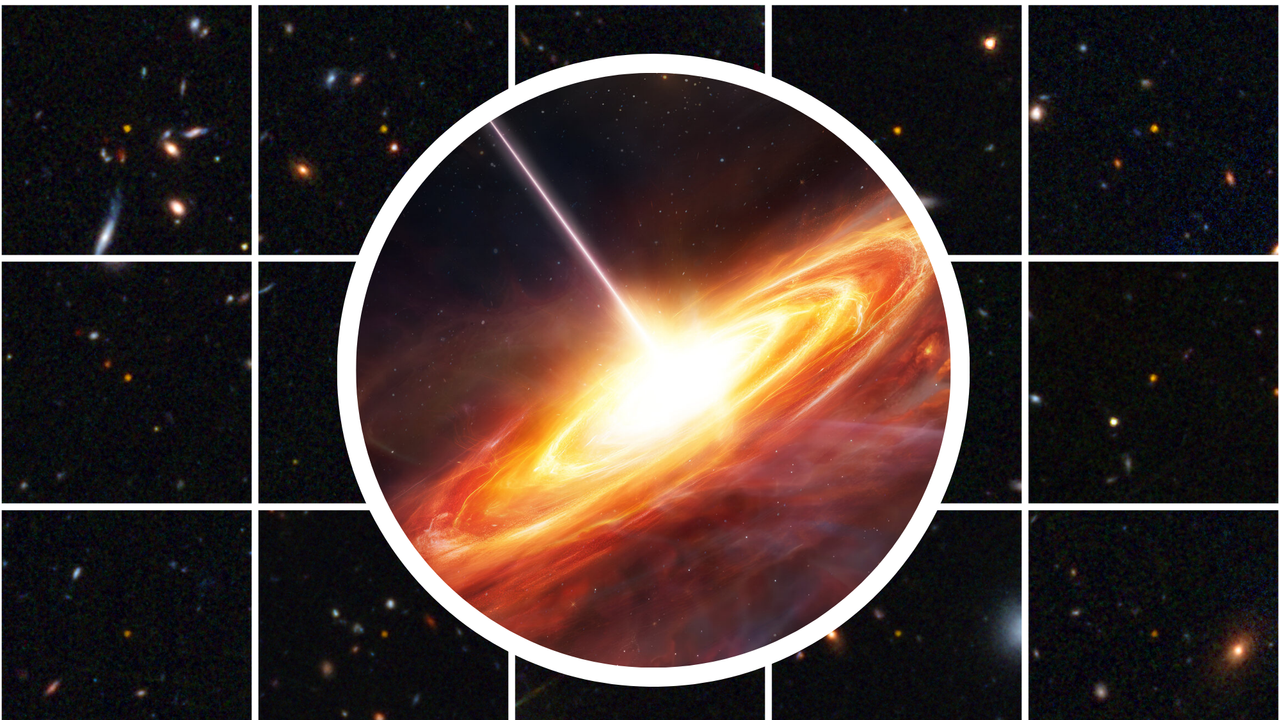
Astronomers have identified the most ancient and distant quasar ever observed, utilizing the European Space Agency's (ESA) Euclid space telescope. This discovery is part of a larger treasure trove of quasars found in the early universe, all powered by supermassive black holes. The newly found quasar is exceptionally luminous, emitting light equivalent to that of a trillion suns. Its detection provides valuable insights into the conditions and structures present in the universe's nascent stages. The Euclid telescope's advanced capabilities have enabled scientists to peer further back in time than previously possible, revealing these energetic phenomena from the cosmic dawn. Studying these early quasars helps researchers understand the formation and evolution of galaxies and supermassive black holes in the universe's infancy. This finding represents a significant advancement in observational cosmology and our understanding of the early cosmos.
The discovery of the most distant quasar to date, powered by a black hole and shining with the luminosity of a trillion suns, offers a unique window into the universe's early epochs. Observing such ancient and energetic phenomena allows astrophysicists to test cosmological models and theories regarding the formation of the first large-scale structures and supermassive black holes. The Euclid telescope's role highlights the increasing importance of advanced observational instruments in pushing the boundaries of scientific knowledge. Future research will likely focus on characterizing the properties of this quasar and others like it to refine our understanding of cosmic evolution and the interplay between early galaxies and their central black holes.
AI-generated to prompt reflection — not editorial opinion, not advice, not a statement of fact. How this works.