Astronomers Discover Potential Exomoon, Challenging Definitions of Celestial Bodies
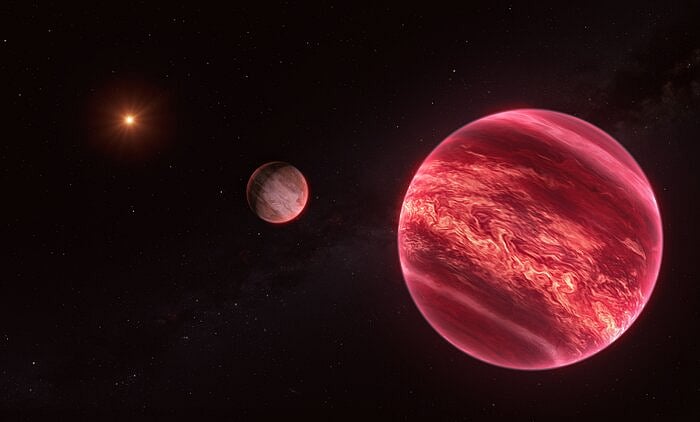
Astronomers have discovered a celestial object orbiting a brown dwarf, which they are tentatively calling an exomoon, located approximately 73 light-years away in the CD-35 2722 system. This system features a star roughly half the mass of our Sun, orbited by a brown dwarf. Brown dwarfs are celestial bodies that form like stars but lack sufficient mass for hydrogen fusion to ignite in their cores, making them larger than gas giants but smaller than the smallest stars. The newly found object is significant because it orbits this brown dwarf, rather than a planet. Researchers, led by Kevin when from the Universidad Diego Portales and Millennium Nucleus of Young Exoplanets and Their Moons, acknowledge that this discovery challenges existing definitions of 'moon' and 'planet'. The object is so massive it could be classified as a planet, yet it orbits a body that itself orbits a star, blurring the lines between these classifications. While the team is hesitant to definitively label it an exomoon without revising current definitions, they are confident it represents a novel type of exoplanet satellite, marking a first in astronomical history. This finding, published in the journal Nature, underscores the vast diversity and strangeness of planetary systems beyond our own solar system. Future observations with instruments like the Extremely Large Telescope in Chile are expected to shed more light on such objects and aid in the search for more exomoons.
This discovery highlights a potential gap in astronomical classification systems, particularly as celestial bodies with masses exceeding that of Jupiter are found orbiting objects other than stars. The research prompts a re-evaluation of definitions for planets and moons, suggesting that the traditional distinctions may be insufficient for the diverse phenomena observed in exoplanetary systems. Future classification frameworks may need to accommodate a broader spectrum of orbital configurations and mass relationships to accurately categorize these newly found objects. This evolution in understanding could lead to new insights into planetary formation and the dynamics of multi-body systems across the galaxy.
AI-generated to prompt reflection — not editorial opinion, not advice, not a statement of fact. How this works.