Astronomers Map Magnetic Field Around Unusual Pulsar for First Time
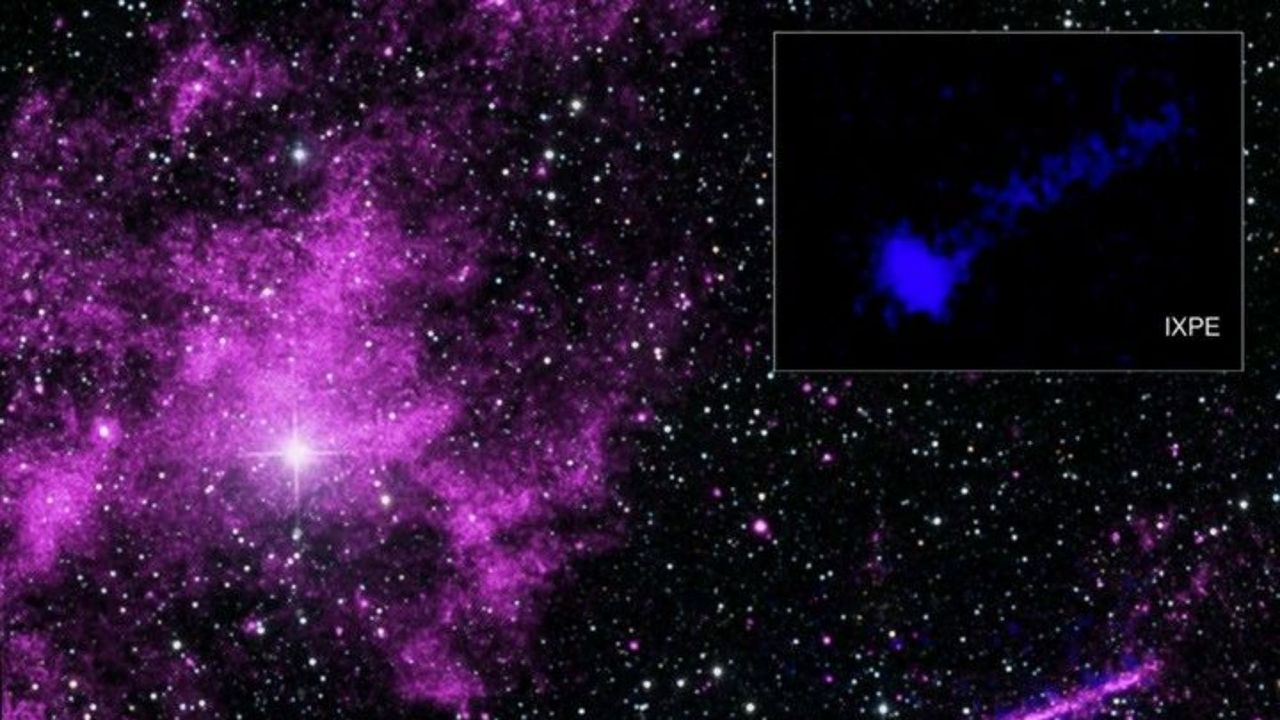
For the first time, astronomers have successfully mapped the magnetic field that surrounds one of the Milky Way's most peculiar pulsars. This groundbreaking observation confirms a long-standing prediction regarding the outward flow of particles from this rapidly spinning stellar remnant. Pulsars are known for their intense magnetic fields and rapid rotation, often emitting beams of radiation that sweep across space like a lighthouse. The ability to directly map the magnetic field provides crucial insights into the complex physics governing these extreme celestial objects. This research opens new avenues for understanding particle acceleration and energy dissipation in the vicinity of pulsars. The findings are expected to refine theoretical models of pulsar behavior and their impact on the interstellar medium. This direct mapping represents a significant advancement in observational astrophysics, offering a clearer picture of the magnetic environment around these cosmic powerhouses.
This direct mapping of a pulsar's magnetic field offers a significant empirical validation for theoretical models of particle emission. Understanding these magnetic structures is crucial for comprehending the energetic processes within our galaxy and the broader universe. The ability to observe and quantify these fields allows for a more precise calibration of astrophysical simulations, potentially refining our understanding of cosmic ray origins and the dynamics of neutron stars. Future research may leverage these findings to explore the influence of magnetic fields on exoplanetary systems orbiting such objects, though direct observation remains a significant challenge. This advancement underscores the ongoing synergy between theoretical prediction and observational capability in pushing the frontiers of astrophysics.
AI-generated to prompt reflection — not editorial opinion, not advice, not a statement of fact. How this works.