Astronomers Observe Black Hole's "Indigestion" Event
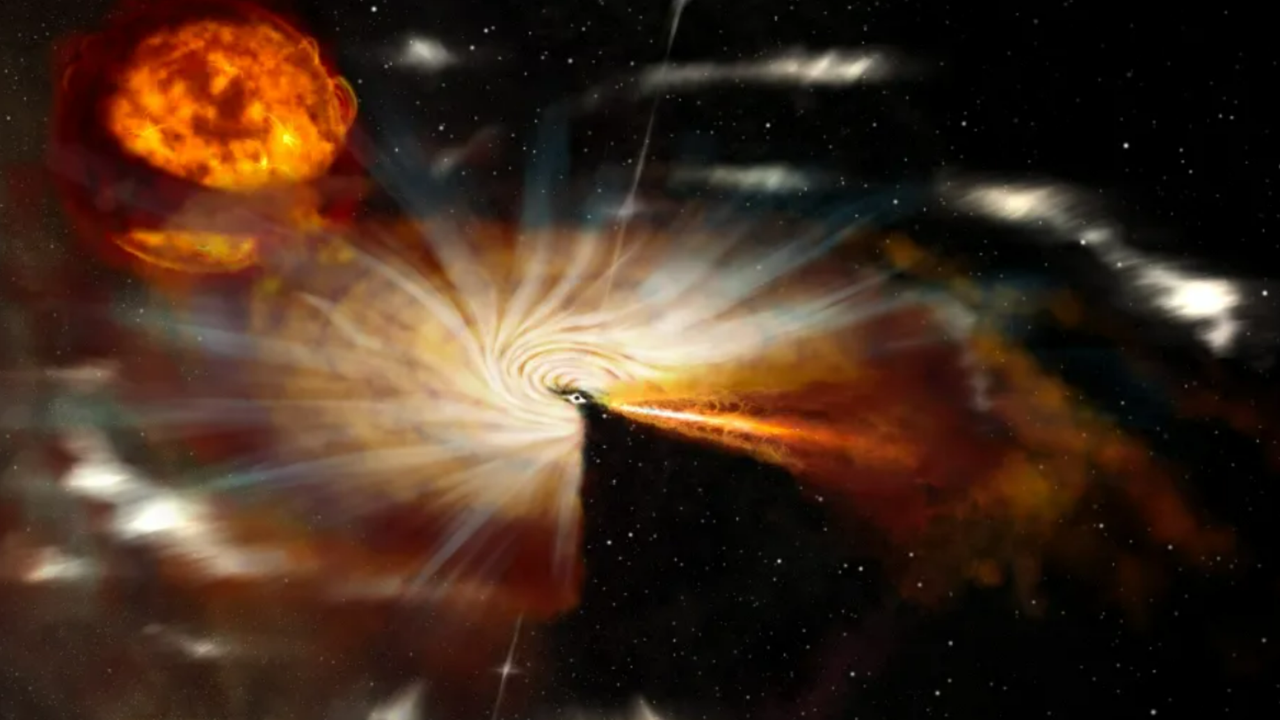
Astronomers have observed a remarkable event where a distant black hole's "feeding frenzy" concluded with a significant outburst. This cosmic phenomenon, likened to "cosmic indigestion," involved the black hole expelling material after consuming a large amount of matter. The outburst was characterized as a windy expulsion, suggesting a powerful release of energy and gas. This observation provides new insights into the complex processes occurring around black holes. Scientists are studying these events to better understand the dynamics of accretion disks and the energetic jets that can be launched from the vicinity of these massive objects. The "feeding frenzy" likely refers to a period where the black hole was actively accreting matter, possibly from a star or gas cloud. The subsequent "windy outburst" indicates that not all consumed material is retained, and some is ejected back into space. This cyclical process of consumption and expulsion plays a crucial role in shaping the surrounding environment and the evolution of galaxies. Further research will aim to quantify the energy involved and the composition of the ejected material.
This observation of a black hole's energetic expulsion offers a window into the complex feedback mechanisms governing galactic evolution. The event highlights that accretion processes are not solely about consumption but also involve significant outflows, which can regulate star formation in the host galaxy. Understanding the efficiency of these ejections and their impact on the interstellar medium is critical for refining cosmological models. Future research may focus on the specific conditions that trigger such outbursts and their correlation with different types of black hole environments, potentially revealing universal principles of astrophysical dynamics.
AI-generated to prompt reflection — not editorial opinion, not advice, not a statement of fact. How this works.
