Astronomers Uncover Rare Stellar Explosion Lacking Hydrogen
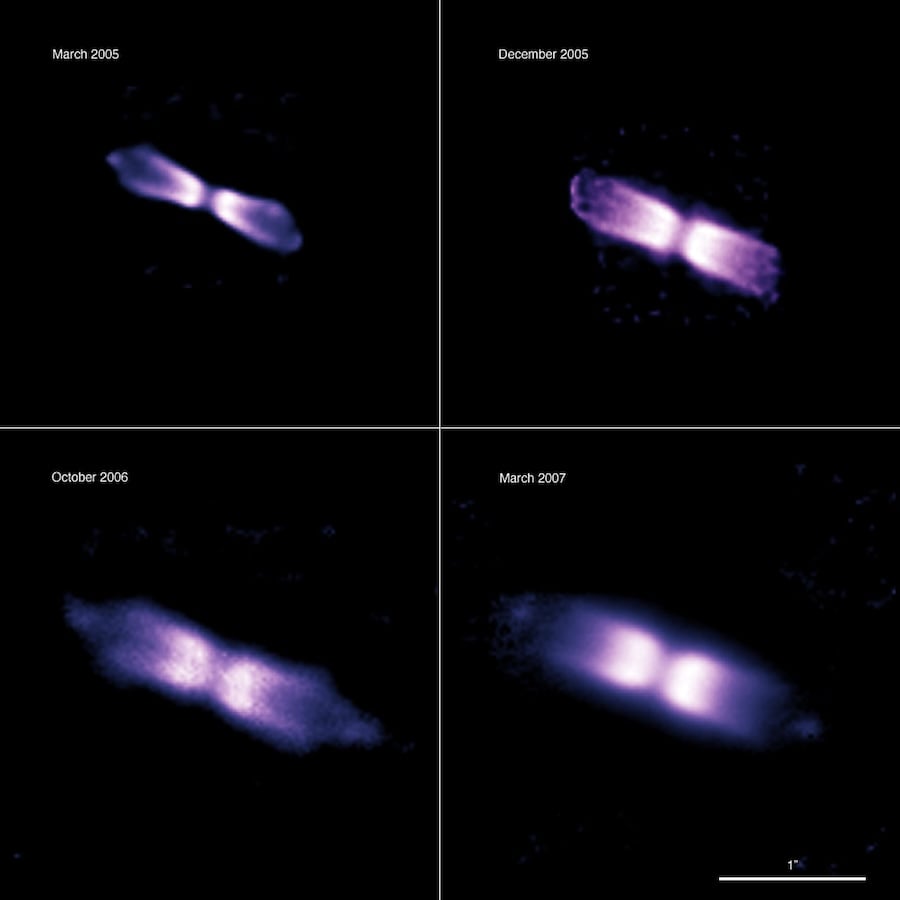
Twenty-five years ago, a star in the constellation Puppis exploded, leaving astronomers puzzled by the complete absence of hydrogen, the universe's most abundant element. The star's self-created dust cloud obscured the event for years. Recently, the dust has cleared, revealing a white dwarf star consuming a rare helium star. This unusual stellar interaction produced unexpected results: clumps of gas ejected at speeds of twenty million miles per hour. The origin of these high-speed gas clumps remains unknown to scientists.
This astronomical event highlights the dynamic and sometimes unpredictable nature of stellar evolution. The discovery of a hydrogen-deficient explosion, driven by a white dwarf accreting matter from a helium star, challenges existing models of stellar remnants. The unexpected ejection of gas at extreme velocities suggests that current astrophysical theories may not fully account for all possible outcomes in binary star systems. Further investigation into the precise mechanisms driving these high-speed expulsions could refine our understanding of energy transfer and mass loss in such environments, potentially impacting models of galactic chemical enrichment and supernova progenitors over the next decade.
AI-generated to prompt reflection — not editorial opinion, not advice, not a statement of fact. How this works.