Attacks on Hospitals in Conflicts Now Occur with Impunity, Undermining Legal Protections
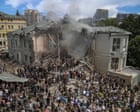
Foundational legal protections in conflict zones are increasingly being bypassed, leading to healthcare personnel being treated as legitimate targets. This trend is evident in ongoing conflicts from Ukraine to Lebanon, where international laws and norms are routinely disregarded. The situation is further complicated by political developments, such as Donald Trump's announcement of a deal for the complete disarmament of Hamas in Gaza, which has been met with caution due to apparent disputes over its implementation. Both Israel and Hamas face accusations of war crimes, and the International Criminal Court has issued arrest warrants, yet the perceived illegality of actions, including military operations in Iran, seems to have lost its impact on the global stage. Multinational institutions are also experiencing degradation in their effectiveness. In other news, a wildfire in Suffolk, England, prompted the evacuation of hundreds of people and the declaration of a major incident near the Sizewell B nuclear power station. UK politics saw Labour accuse Reform UK of sleaze over substantial donations from the mother of a convicted fraudster, urging an Electoral Commission investigation. In Europe, Spain deployed additional troops and police to its North African enclave of Ceuta following a large influx of migrants from Morocco. Finally, the co-founder of Palestine Action has gained permission to challenge a ban against the group at the UK's highest court.
The erosion of legal protections for healthcare facilities and personnel in conflict zones represents a critical breakdown in international humanitarian law. This impunity suggests that enforcement mechanisms are insufficient or politically compromised, allowing state and non-state actors to disregard established norms with minimal consequence. The degradation of multinational institutions further exacerbates this issue, weakening the global framework designed to uphold such protections. Looking ahead, the increasing prevalence of asymmetric warfare and the blurring lines between combatants and civilians, amplified by advanced surveillance and communication technologies, will continue to challenge existing legal structures. Addressing this requires a re-evaluation of accountability frameworks and a strengthening of international resolve to protect civilian infrastructure and personnel, even amidst geopolitical tensions.
AI-generated to prompt reflection — not editorial opinion, not advice, not a statement of fact. How this works.