Attempt to Revive Fascism Ongoing by Supporters of Ousted Party: AB Party Chairman
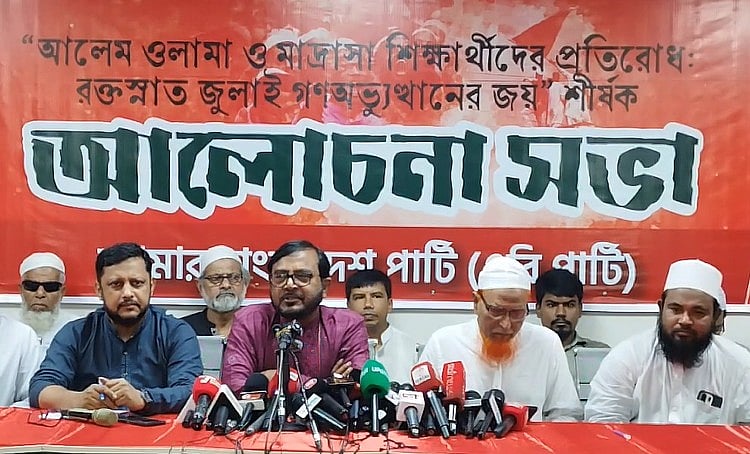
The Awami League, ousted in a July coup two years ago and now facing sanctions, has disappeared from the political arena. However, some of its supporters remaining in the country are attempting to keep the party relevant, according to Mujeebur Rahman Manju, Chairman of the Amar Bangladesh Party (AB Party). Manju stated that while the forces defeated in 1971 surrendered and fled to Pakistan, their collaborators and 'ghosts' like Razakars and Al-Badr regrouped and found refuge in various political parties, with a significant number historically joining the Awami League. He asserted that even now, after the end of the Awami League's alleged fascist rule in 2024 following a student-led uprising, some of these collaborators and 'ghosts' remain in the country, actively trying to make fascism relevant through indirect means. The Awami League's activities have been banned since the coup, and its top leaders, including President Sheikh Hasina, have reportedly fled abroad. Manju raised concerns about the activities of Awami League supporters still in Bangladesh during a discussion at the AB Party's central office in Bijoynagar, Dhaka. The event, titled 'Scholars, Clerics, and Madrasa Students' Resistance: The Victory of the Blood-Soaked July Uprising,' commemorated the second anniversary of the July uprising. He emphasized that scholars and clerics, usually distant from active party politics, have historically shown leadership and courage during national crises, participating in the July uprising alongside university students. The uprising succeeded when people from all walks of life, including students from universities, colleges, private universities, and madrasas, along with men, women, and cultural activists, took to the streets. He hailed these students and clerics as the nation's greatest heroes. Ahmad Ali Qasemi, Senior Vice-Amir of Khelafat Majlis, attributed Sheikh Hasina's downfall to long-accumulated public anger, achieved through the unified movement of all patriotic forces. Manju called for structural reforms based on the July Charter to prevent future fascism, and Maulana Sanaullah Khan of the National Olama Alliance suggested that the seeds of the July uprising were sown on May 5, 2013, at Shapla Square.
The analysis suggests that the political discourse highlights a narrative of a defeated ideology attempting to reassert itself through remaining sympathizers. This framing frames the current political landscape as a continuation of historical struggles, where remnants of a past regime are perceived as actively working to regain influence. The emphasis on structural reforms and historical parallels indicates a focus on systemic issues and the long-term consequences of political transitions. The discussion also points to the role of various societal groups, including religious scholars and students, in driving political change, suggesting a complex interplay of forces beyond traditional party politics. The underlying theme is the challenge of consolidating democratic gains and preventing the resurgence of authoritarian tendencies through institutional mechanisms and broad societal participation.
AI-generated to prompt reflection — not editorial opinion, not advice, not a statement of fact. How this works.