Bangladesh Advocates for SAARC's Pragmatic Revival Amidst Political Hurdles
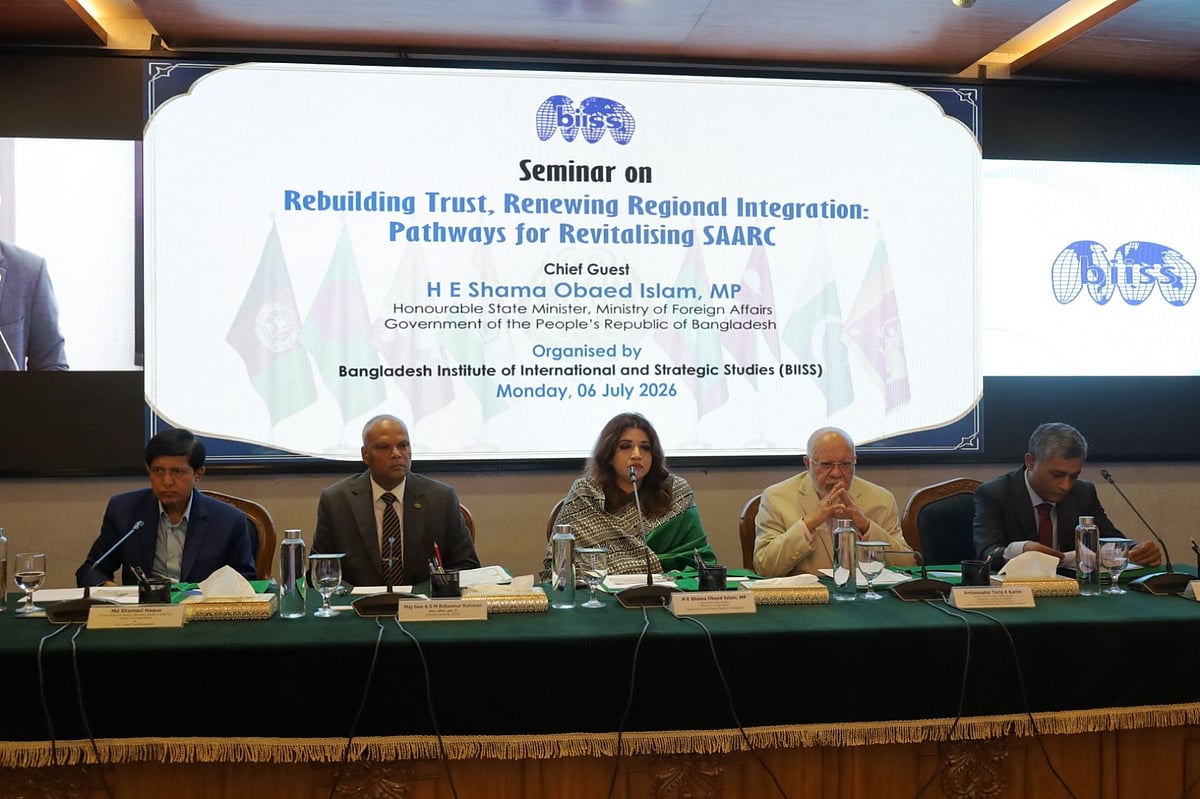
Foreign Minister Shama Oubaid of Bangladesh has emphasized the potential for the South Asian Association for Regional Cooperation (SAARC) to address common issues even without resolving political disputes. Speaking at a seminar in Dhaka on the revitalization of SAARC, organized by the Bangladesh Institute of Strategic Studies (BISS), she highlighted SAARC's role as a platform for smaller nations to voice collective concerns, for India to demonstrate regional leadership, and for Pakistan to remain integrated within the South Asian framework. The seminar, titled 'Rebuilding Trust, Renewing Regional Integration: Pathways to Revitalize SAARC,' featured a keynote by former High Commissioner to India, Tareq A. Karim. Panelists included former Additional Foreign Secretary M. Shamsul Haque and Professor Niloy Ranjan Biswas. Oubaid acknowledged that SAARC has been hampered by political mistrust, bilateral disputes, cross-border tensions, power imbalances, and competitive security perceptions. However, she stressed that SAARC's objective is not to force political dialogue but to ensure that bilateral tensions do not paralyze regional cooperation. Bangladesh maintains a realistic and hopeful stance, believing that while immediate full political normalization is unlikely, significant progress is achievable through pragmatic, technical, and welfare-oriented programs. Oubaid proposed preserving the institution, strengthening its effective components, reforming weaknesses, and fostering cooperation where consensus exists to rebuild mutual trust. She also clarified that Bangladesh sees no need to choose between SAARC and BIMSTEC, advocating for a complementary relationship where sub-regional initiatives support broader regional cooperation. During the seminar, a map presented by Tareq A. Karim showing Jammu and Kashmir incorrectly led to objections from representatives of India and Pakistan, underscoring the lingering sensitivities surrounding the region.
The discourse surrounding SAARC's revitalization, as articulated by Bangladesh's Foreign Minister, navigates the complex interplay between political realities and functional cooperation in South Asia. The proposed approach of pursuing pragmatic, technical, and welfare-oriented initiatives, irrespective of unresolved bilateral political disputes, reflects a strategic attempt to maintain institutional relevance and foster incremental progress. This strategy acknowledges the limitations imposed by geopolitical tensions while seeking to leverage SAARC's potential for collective problem-solving. The emphasis on preserving the institution and strengthening its effective components, rather than demanding immediate political normalization, suggests a long-term perspective focused on building resilience and trust through tangible outcomes. The parallel consideration of BIMSTEC highlights a broader regional integration strategy, where diverse platforms are viewed as complementary rather than competitive, aiming to maximize connectivity and economic benefits across different configurations of South Asian and Southeast Asian nations. The incident involving the disputed map of Jammu and Kashmir serves as a potent reminder of the deep-seated political sensitivities that continue to challenge regional cohesion and the diplomatic finesse required to manage such issues within collaborative frameworks.
AI-generated to prompt reflection — not editorial opinion, not advice, not a statement of fact. How this works.