Bangladesh Grapples with 'Post-Truth Era' Amidst Political and Social Division
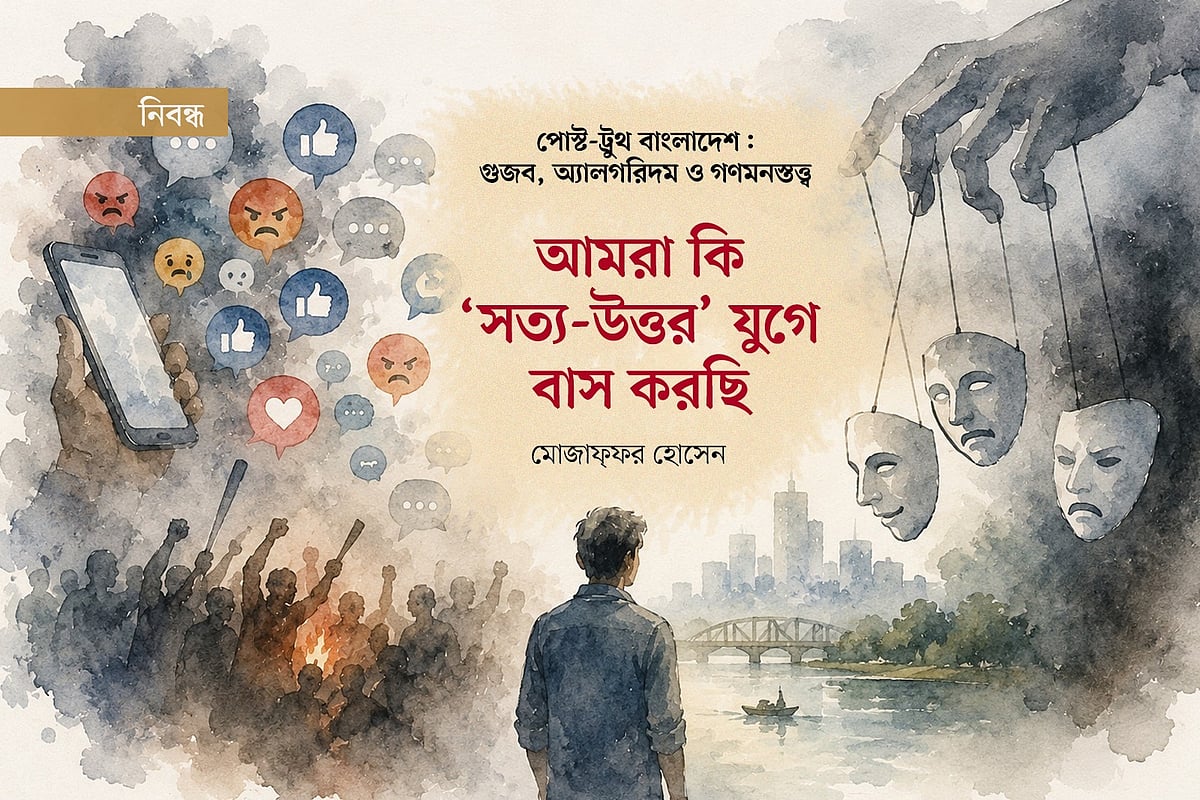
Bangladesh is currently experiencing a profound political and social crisis, characterized by deep divisions, a lack of trust in personal relationships, mob violence, communal hatred, and a society built on rumors. This environment blurs the lines between truth and falsehood, where unverified information like videos, screenshots, edited photos, or anonymous posts can reach millions within hours. By the time such content is debunked, significant harm, including physical violence or property destruction, may have already occurred. This situation is not solely a product of technology but also stems from a decline in values and ongoing political instability.
The article describes this phenomenon as the 'post-truth era,' where emotions, personal beliefs, and political ideologies hold more sway in shaping public opinion than objective facts. Instead of confronting reality, people often embrace 'alternative truths' or 'hyperreality,' creating a 'co-created fiction' often fostered by politicians and their supporters. Politicians frequently make irresponsible statements, often disseminating misinformation with impunity, aiming to send a specific 'signal' to their base rather than ensuring factual accuracy. Supporters may perceive such leaders as 'fearless' and 'truthful,' even fabricating justifications for their leaders' false claims. This dynamic is exemplified by the quote from Elina Gorokhova's autobiography: 'They lie to us, we know they're lying, they know we know they're lying, but they keep lying to us, and we keep pretending to believe them.' The article cites former US President Donald Trump's extensive record of false or misleading statements, noting that public perception, rather than factual accuracy, now dictates political standing.
The proliferation of misinformation in Bangladesh, as described, highlights a critical challenge in the digital age where emotional resonance and ideological alignment often supersede factual verification. This phenomenon, termed the 'post-truth era,' is exacerbated by social media algorithms designed to maximize user engagement by reinforcing existing beliefs, creating 'echo chambers.' This system inadvertently cultivates a societal environment where objective debate becomes difficult, as opposing sides operate within distinct, self-validating information realities. The economic model of 'surveillance capitalism,' where user data and emotional responses are commodified, further incentivizes the creation and dissemination of content that appeals to sentiment rather than truth. This dynamic poses a significant risk to democratic discourse and social cohesion, as it can be exploited to manipulate public opinion and incite division, particularly in regions with existing political and social fragilities. Addressing this requires a multi-faceted approach, focusing on digital literacy, algorithmic transparency, and fostering critical thinking skills to navigate an increasingly complex information landscape.
AI-generated to prompt reflection — not editorial opinion, not advice, not a statement of fact. How this works.