Bangladesh Makes History at International Math Olympiad, All Competitors Win Medals
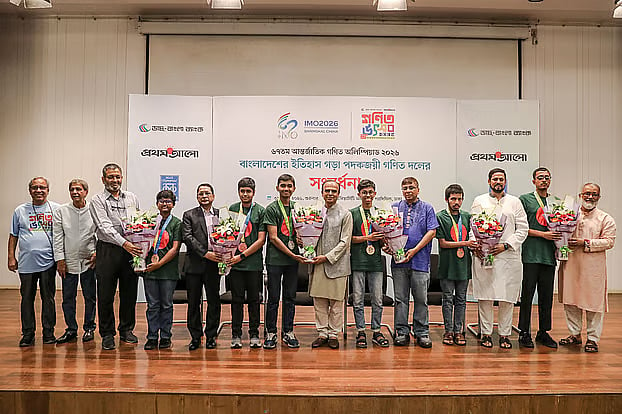
Bangladesh achieved a historic milestone at the 67th International Mathematical Olympiad held in Shanghai, China, with all six participating students securing medals. This remarkable success was celebrated at a reception hosted by the University of Asia Pacific in Dhaka. The Bangladeshi team amassed a total of 121 points, marking their highest-ever team score in the competition's history. With one silver and five bronze medals, Bangladesh secured 39th place among 117 participating countries.
The silver medal was won by Md. Raihan Siddiqui, a 12th-grade student from Chittagong College. The bronze medalists include Tahsin Khan from Anand Mohan College, M. Jamiul Hossain from RAJUK Uttara Model College, Jawad Hameem Chowdhury from Dhaka Imperial College, Monami Zaman from Viqarunnisa Noon School and College, and Mohammad Marjuk Rahman from Chittagong Cantonment English School and College. The event was attended by prominent figures including Professor Mohammad Ataul Karim, former Executive Vice-Chancellor of the University of Massachusetts Dartmouth, and Professor Mohammad Kaykobad, President of the Bangladesh Mathematical Olympiad Committee.
This achievement highlights the growing strength of Bangladesh's participation in international academic competitions, underscoring the importance of dedicated programs like the Mathematical Olympiad. The success of all six competitors signifies a robust talent pool and effective coaching, suggesting a positive trajectory for STEM education in the country. Looking ahead, fostering an environment that encourages not only mathematical prowess but also critical thinking, communication, and lifelong learning will be crucial for translating these individual successes into broader societal and economic advancements in the AI era. Continued investment and strategic development of such initiatives can position Bangladesh as a significant contributor to global scientific and technological progress.
AI-generated to prompt reflection — not editorial opinion, not advice, not a statement of fact. How this works.