Bangladesh Offers Tax Rebates for Early Income Tax Filers
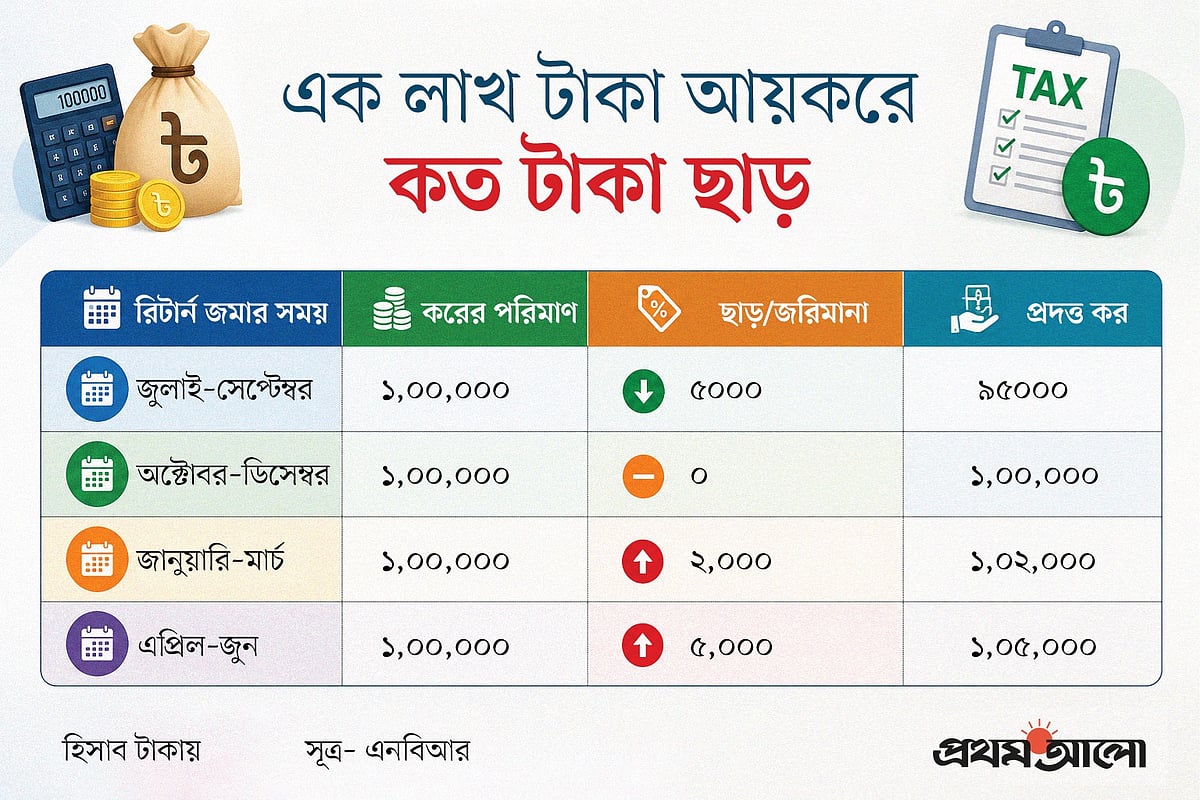
The National Board of Revenue (NBR) in Bangladesh has introduced a new incentive system for taxpayers who file their income tax returns early. Individuals filing their returns by September will receive a special tax rebate. For instance, if one's tax liability is BDT 100,000, they will only need to pay BDT 95,000, effectively receiving a BDT 5,000 tax exemption. This 5% rebate on the tax payable applies to all returns filed before the September deadline. This initiative aims to encourage timely tax compliance, contrasting with penalties for late submissions. Currently, Bangladesh has over 12.5 million Tax Identification Number (TIN) holders, with more than 4.5 million filing returns online last year. The NBR has structured rebates and penalties based on the filing quarter. Filing in the first quarter (July-September) offers a 5% rebate or BDT 25,000 (whichever is less) on the payable tax. No incentives are offered for filing in the second quarter (October-December). However, returns filed in the third quarter (January-March) will incur a penalty of 2% of the payable tax or BDT 3,000 (whichever is higher), with a maximum penalty of BDT 3,000. For returns filed in the fourth quarter (April-June), the penalty is 5% of the payable tax or BDT 5,000 (whichever is higher), capped at BDT 5,000. Taxpayers can file returns online by visiting the NBR website, logging in, and providing details of their income, investments, expenses, assets, and liabilities. Payments can be made conveniently from home using various mobile financial services and bank transfer options.
The NBR's new tiered rebate system incentivizes early tax filing, potentially improving revenue collection efficiency and taxpayer engagement. By offering financial benefits for prompt submission, the policy aims to smooth out the tax collection process throughout the fiscal year, reducing the year-end rush. This approach leverages behavioral economics by providing immediate rewards for desired actions, contrasting with the deterrent effect of penalties for delays. The system's structure, however, introduces complexity and differential treatment based on filing dates, which could be perceived as arbitrary by some taxpayers. Future iterations might consider simplifying the structure or linking benefits more directly to broader tax compliance behaviors beyond mere filing timeliness.
AI-generated to prompt reflection — not editorial opinion, not advice, not a statement of fact. How this works.