Bannu Operation: One Terrorist Killed, Eight Detained in Ongoing Counter-Terrorism Efforts
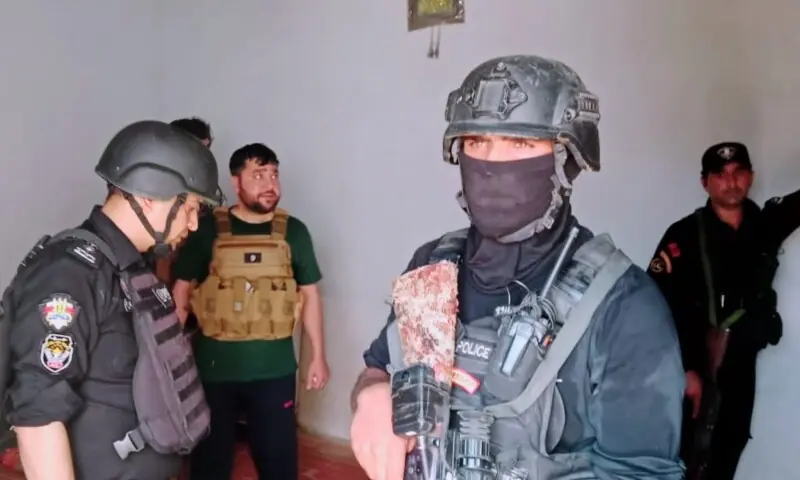
An intelligence-based operation (IBO) in Pakistan's Bannu district, Khyber Pakhtunkhwa, continued for its third day on Sunday, resulting in the death of one terrorist and the apprehension of eight individuals. The operation, led by Bannu District Police Officer Captain (retd) Muhammad Furqan Bilal, involved a joint effort by the district police, Elite Force, Counter-Terrorism Department (CTD), and the army in the village of Grera Shah Jahan. During the operation, a terrorist was killed while attempting to plant an improvised explosive device (IED), and authorities recovered an AK-47 rifle, magazines, and a bandolier. Eight suspicious individuals were detained and handed over to the CTD and district police for investigation. Authorities also seized two motorcycles and a rickshaw from the residence of a wanted terrorist named Zargul, also known as "Uncle."
This ongoing operation follows a significant increase in terrorist activities in Bannu, including attacks on police and suicide bombings, as reported by the military's media wing, Inter-Services Public Relations (ISPR). The ISPR attributed these attacks to "Indian proxy Fitna-al-Khawarij," a term used for the Tehreek-i-Taliban Pakistan (TTP). Bannu has experienced numerous security incidents recently, with both civilians and security forces targeted. In a prior incident on Wednesday night, a police official was killed and several others injured when terrorists attacked the Miryan Police Station with an explosives-laden vehicle, followed by an exchange of fire. Police and security forces have committed to continuing joint operations to combat terrorism, maintain law and order, and ensure public safety.
The ongoing counter-terrorism operations in Bannu highlight the persistent challenge of militant violence in the region. The framing of the conflict, particularly attributing attacks to external proxies, suggests a geopolitical dimension that may influence domestic security strategies and public perception. The extensive use of intelligence-based operations, combined with army and CTD involvement, indicates a comprehensive approach to dismantling terror networks. However, the cyclical nature of such incidents raises questions about the long-term effectiveness of current strategies in addressing the root causes of extremism and ensuring sustainable peace. Future efforts may need to consider broader societal and economic factors alongside security measures to achieve lasting stability, especially in the context of evolving regional dynamics and technological advancements in both warfare and surveillance.
AI-generated to prompt reflection — not editorial opinion, not advice, not a statement of fact. How this works.