Bengal Tigers in Captivity: A Glimpse at National Zoo Residents
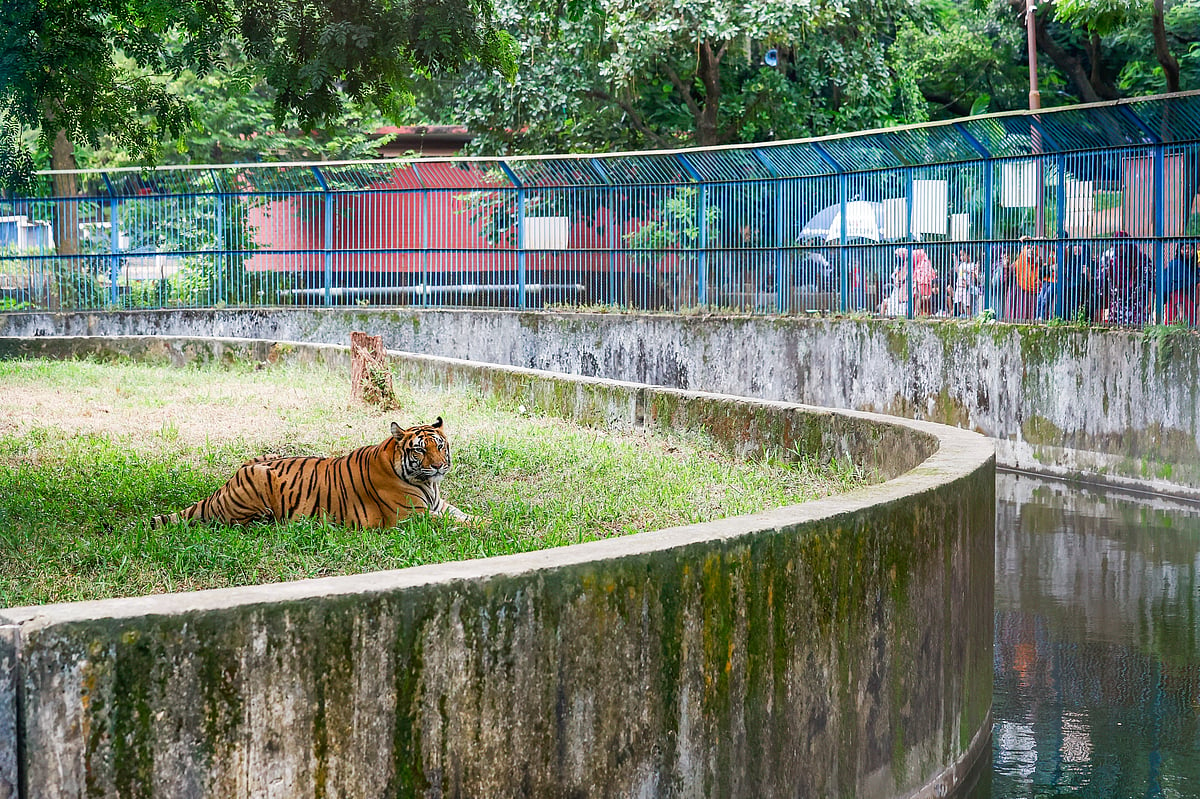
The Bengal tiger, Bangladesh's national animal, plays a vital role in maintaining ecological balance. However, tigers globally face threats from deforestation, habitat destruction, poaching, and human-tiger conflict. To raise awareness for tiger and habitat conservation, International Tiger Day was established on July 29th annually during the 2010 Tiger Summit in St. Petersburg, Russia. At Bangladesh's National Zoo in Mirpur, Dhaka, Bengal tigers are housed in large enclosures. Visitors can observe these majestic animals resting near water bodies or in shaded areas within their habitats. Images depict a Bengal tiger relaxing, a child observing from its father's lap near the enclosure, and tigers lying on grassy areas or walking along the water's edge. The tigers are also shown engaging in natural behaviors such as scratching their claws on tree stumps within their confined spaces.
International Tiger Day highlights the precarious conservation status of Bengal tigers, underscoring the conflict between human development and wildlife preservation. While zoos like the National Zoo in Mirpur provide a controlled environment for public education and species display, they also raise questions about the long-term viability of captive breeding programs versus in-situ conservation efforts. The inherent challenges of habitat loss and human-wildlife conflict necessitate innovative strategies that balance ecological needs with community development, potentially involving technological solutions for monitoring and conflict mitigation. Future conservation paradigms will likely integrate advanced data analytics and community-based incentives to foster coexistence and ensure the survival of species like the Bengal tiger beyond the confines of enclosures.
AI-generated to prompt reflection — not editorial opinion, not advice, not a statement of fact. How this works.