Betelgeuse May Have a Companion Star, New Image Offers Strongest Evidence Yet
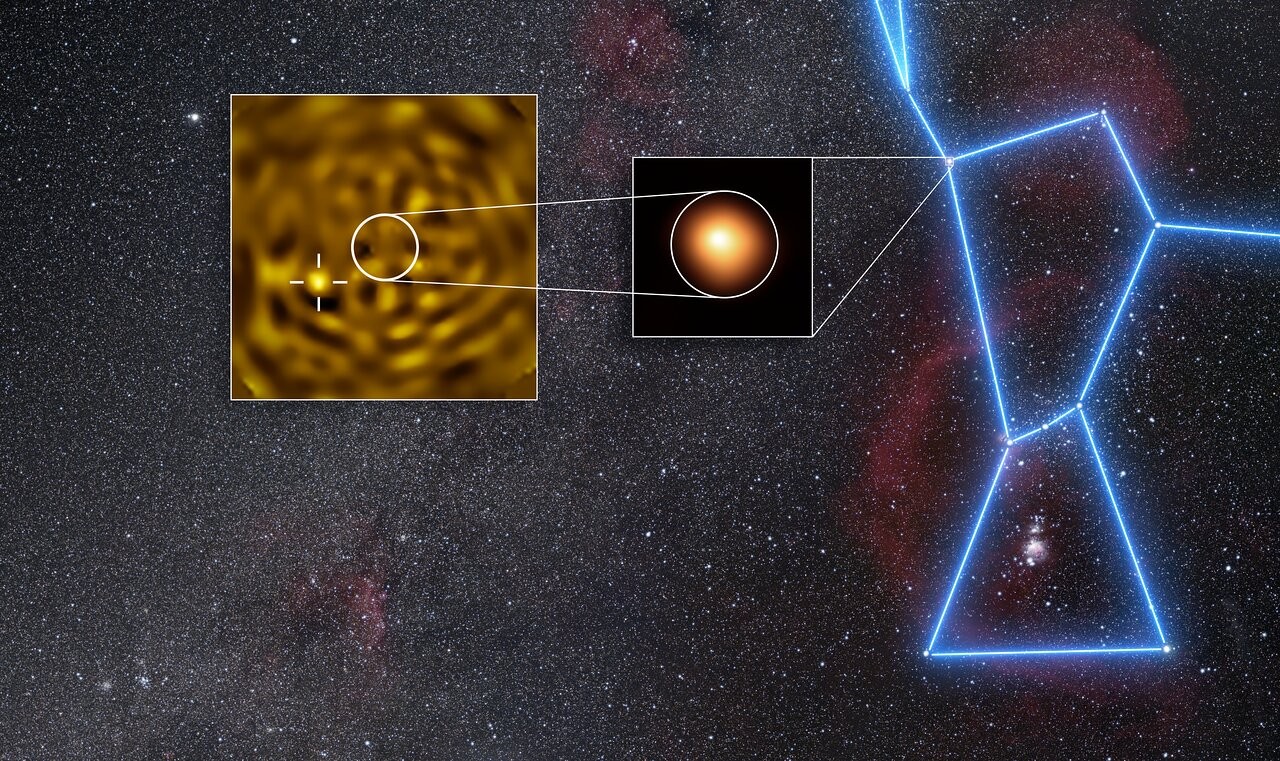
Astronomers have captured the clearest image to date of a potential companion star to Betelgeuse, one of the night sky's most famous red supergiants. This new image provides the strongest evidence yet that Betelgeuse, located in the Orion constellation approximately 640 light-years away, is not a solitary star. The suspected companion, tentatively named Betelgeuse B, appears as a small point of light very close to the main star. This significant discovery was made using the Very Large Telescope in Chile and detailed in a study published in "Astronomy & Astrophysics." Lead author Miguel Montargès of the Paris Observatory described it as the culmination of a century-long search for this companion. Betelgeuse B is estimated to be two to three times more massive than the Sun, exceeding prior assumptions of a solar-mass companion. The team observed the system in December 2024 when Betelgeuse B was favorably positioned. After months of image processing, they successfully isolated the faint light of Betelgeuse B from the overwhelming brightness of its primary star. While a previous detection was hinted at in 2025 from the Gemini North telescope, this new image offers more definitive proof, though researchers are cautiously avoiding definitive confirmation. Further observations are planned for about a year from now. Astronomers predict that Betelgeuse B will eventually spiral into Betelgeuse and be consumed in approximately 10,000 years due to their gravitational interaction. The next optimal viewing opportunity for Betelgeuse B will be in November 2027, when it reaches the farthest point in its orbit.
This astronomical observation highlights the ongoing refinement of our understanding of stellar evolution and binary systems. The detection of a potential companion star to Betelgeuse, a well-studied variable star, underscores the complexity of even seemingly well-understood celestial objects. The technological advancements enabling such detailed imaging, particularly the ability to resolve faint objects near bright ones, are critical for pushing the boundaries of astrophysical research. From a systems perspective, the eventual engulfment of Betelgeuse B by its primary star illustrates the powerful gravitational dynamics that shape stellar lifecycles, offering a rare direct observation of processes that are typically inferred. This event prompts consideration of how such binary interactions might influence the final stages of massive stars and their potential supernova outcomes, a key area of interest in astrophysics over the next decade.
AI-generated to prompt reflection — not editorial opinion, not advice, not a statement of fact. How this works.