Black Hole Collisions Reveal Evidence of Repeated Mergers
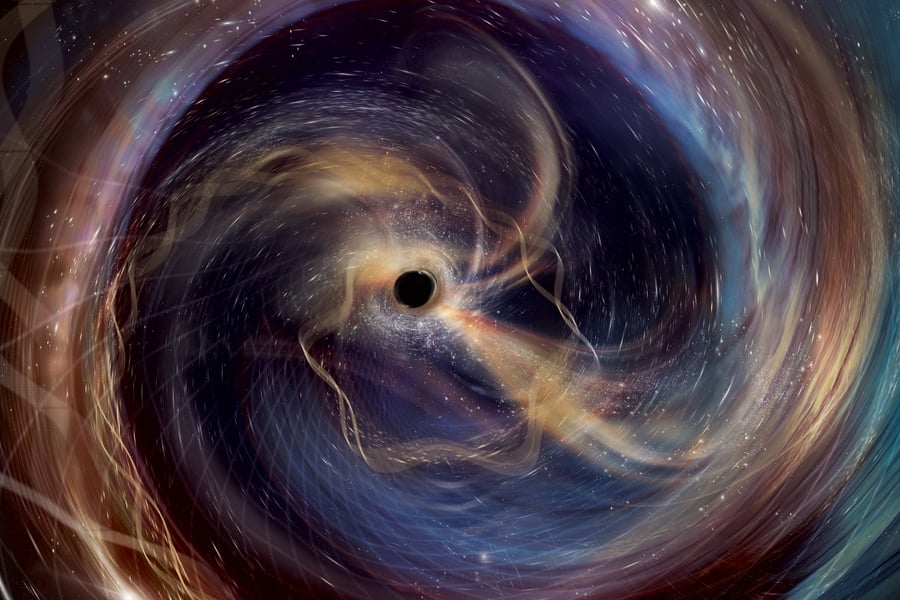
The collision of two black holes represents one of the most energetic and massive events observed in the universe. In this process, two black holes spiral inward, eventually merging to form a single, significantly more massive black hole. This cosmic event is accompanied by the emission of radiation and gravitational waves. These gravitational waves serve as crucial messengers, carrying information about the characteristics and history of the two black holes that participated in the merger. Scientists analyze these waves to understand the dynamics and evolution of these celestial objects.
The observation of black hole mergers provides a unique window into extreme astrophysical phenomena, offering insights into the fundamental laws of gravity and the evolution of massive stellar objects. Analyzing the patterns in gravitational waves from these events can help scientists distinguish between different merger scenarios, potentially revealing whether black holes are prone to multiple, sequential mergers. Understanding these processes is vital for refining cosmological models and comprehending the distribution of mass in the universe. Future advancements in gravitational wave detection technology will likely enable more precise measurements, further illuminating the complex life cycles of black holes and their role in galactic evolution over cosmic timescales.
AI-generated to prompt reflection — not editorial opinion, not advice, not a statement of fact. How this works.