Black Hole Images Act as Time Machines, Physicists Suggest
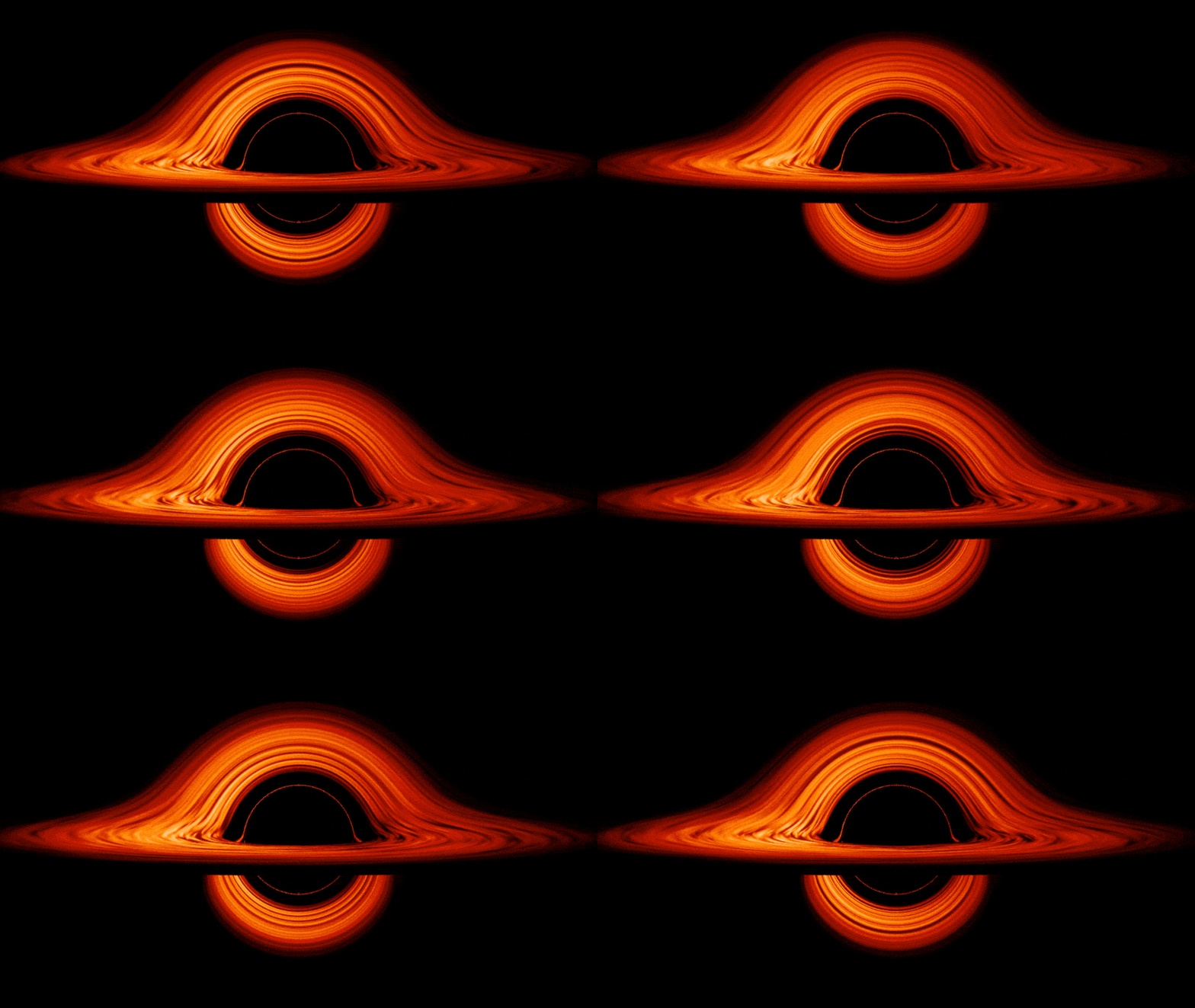
Physicists are exploring the profound implications of images captured of black holes, suggesting that these visual representations are more than just snapshots of distant cosmic phenomena. They propose that every frame within these black hole "movies" functions as a time machine, offering a unique window into the past. This perspective challenges conventional understandings and implies that our current interpretations might be overly simplistic. The scientific community is beginning to delve deeper into how these images can be utilized to understand the evolution of spacetime and the fundamental laws of physics. The ability to observe different temporal states through these images opens up new avenues for theoretical and observational cosmology. Researchers are working to refine methods for extracting temporal information from these complex visual data sets. This advancement could significantly enhance our comprehension of the universe's history and its future trajectory. The ongoing research aims to unlock the full potential of black hole imagery in pushing the boundaries of scientific knowledge.
The assertion that black hole images function as time machines highlights a fundamental aspect of observational cosmology: light travel time. Observing distant objects inherently means viewing them as they were in the past. This perspective, while scientifically accurate regarding light propagation, prompts an examination of how scientific communication frames complex concepts. Overemphasizing the 'time machine' aspect without sufficient context risks sensationalism, potentially obscuring the rigorous scientific process involved. It also invites reflection on how the public perceives scientific discovery, and whether current framing adequately prepares audiences for the nuanced realities of astrophysical research. Future advancements in imaging and data analysis will likely refine our understanding of cosmic history, but clarity in communication remains paramount to fostering informed public engagement.
AI-generated to prompt reflection — not editorial opinion, not advice, not a statement of fact. How this works.