Black Holes Expel Significant Matter, Challenging Devouring Narrative
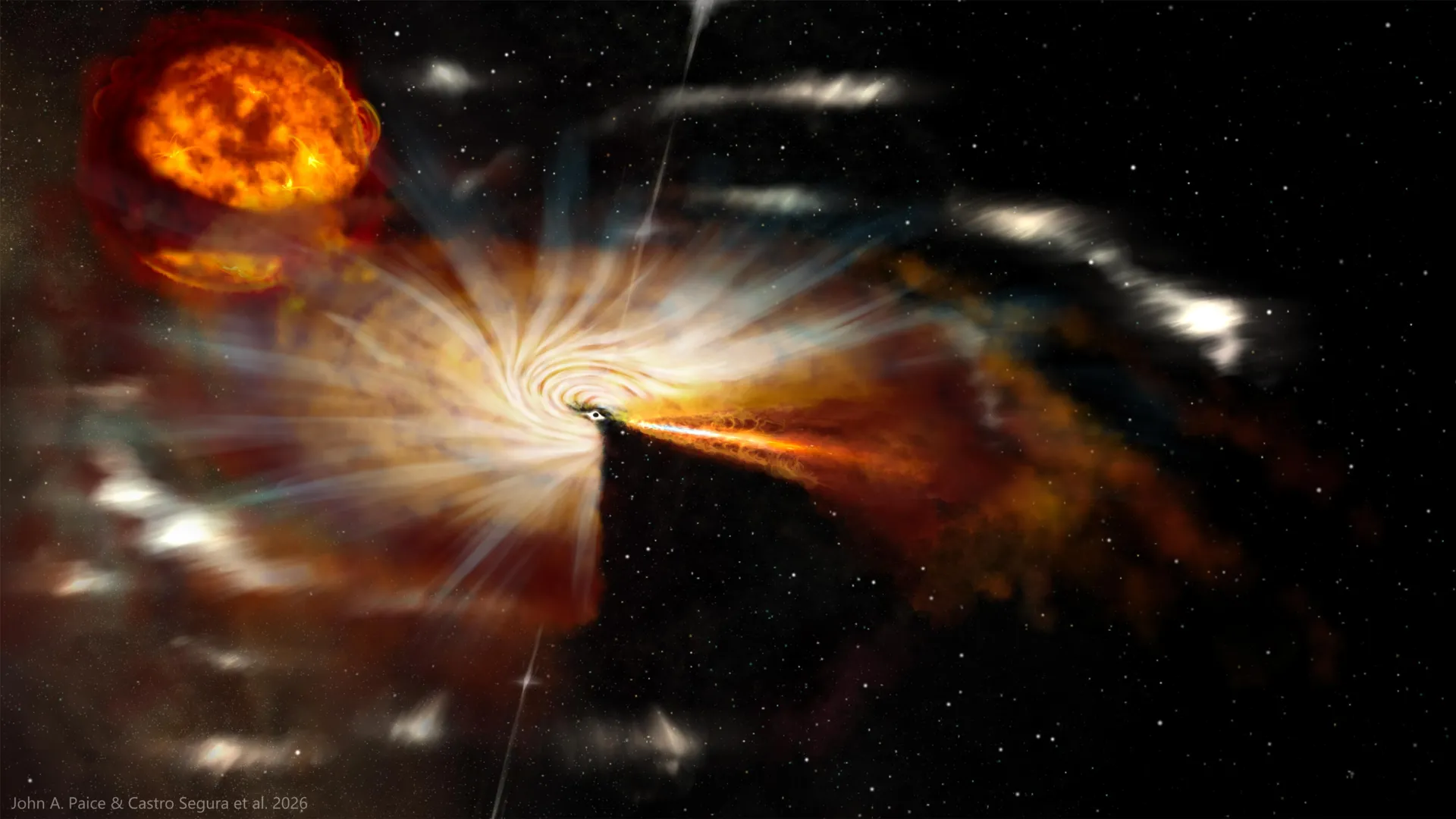
Recent observations of a black hole during a 2023 eruption have revealed that these cosmic entities do not solely consume matter. Instead, the black hole actively expelled substantial amounts of material through powerful jets and winds. This expulsion occurred even as the dramatic outburst was nearing its end. The findings suggest that black holes play a more active role in reshaping their environments than previously understood. They continue to influence their surroundings long after their most intense periods of activity have subsided. This challenges the simplistic view of black holes as mere cosmic vacuum cleaners. The research indicates a dynamic interplay between accretion and ejection processes in these extreme astrophysical objects. These processes have significant implications for understanding galactic evolution and the distribution of matter in the universe.
This observation reframes the understanding of black hole behavior, moving beyond the simplistic 'devouring' model. The active expulsion of matter indicates complex feedback mechanisms within accretion disks and jet formation. This suggests that black holes are not just passive sinks but dynamic agents that can significantly influence the surrounding interstellar medium, potentially regulating star formation in galaxies. Future research should explore the precise physical processes governing the balance between accretion and ejection, and how this balance evolves over cosmic timescales. Understanding these dynamics is crucial for accurately modeling galactic evolution and the distribution of matter in the universe, especially in the context of large-scale structure formation.
AI-generated to prompt reflection — not editorial opinion, not advice, not a statement of fact. How this works.