Black Vulture Struggles for Balance on Floating Caiman Carcass in Brazil's Pantanal
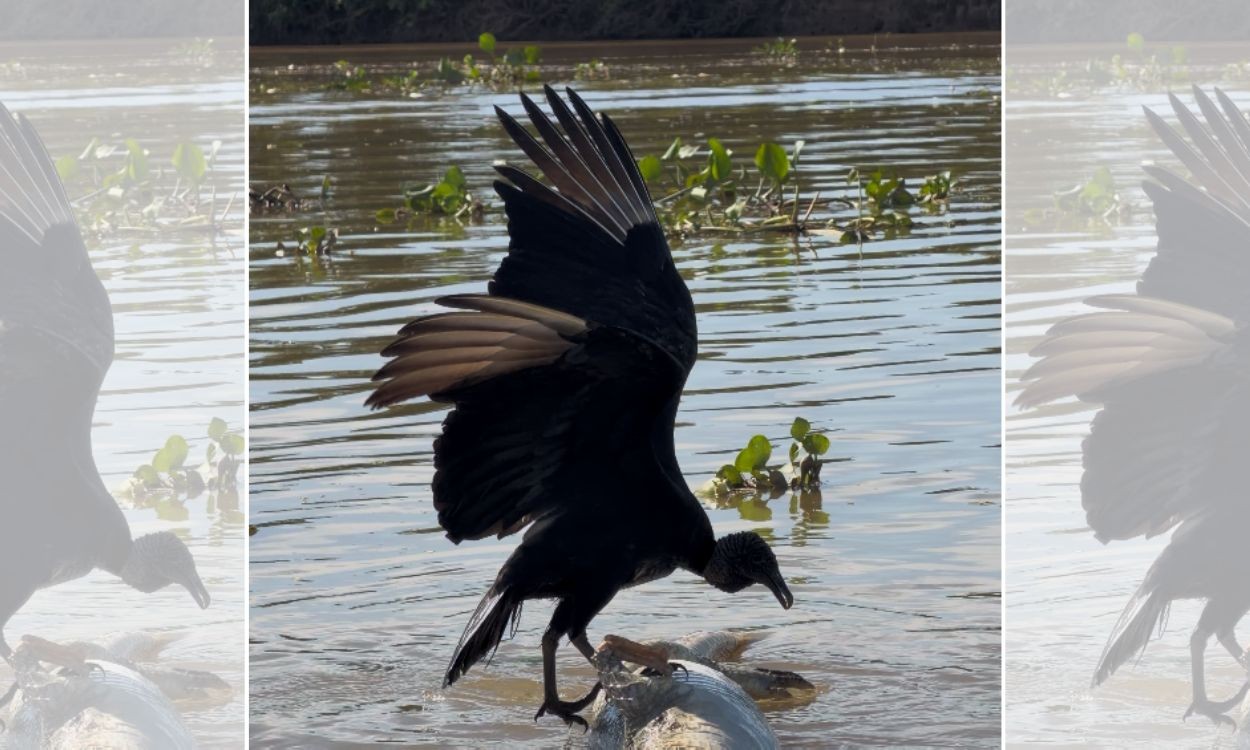
A black vulture (Coragyps atratus) was filmed attempting to feed on a floating caiman carcass in the Cuiabá River, located in Brazil's Pantanal region of Mato Grosso. The reptile's body, likely a yacare caiman (Caiman yacare) or broad-snouted caiman (Caiman latirostris), was bobbing and rotating under the vulture's claws as it tried to eat. The unusual sight was captured on July 9th between Porto Jofre and Poconé by tour guide Mateus Filipe Rauber, 33, while he was accompanying a German family searching for jaguars. Rauber noted that while vultures feeding on dead caimans is common, the bird's difficulty in balancing on the inflated carcass was a unique and humorous spectacle. Ornithologist Guilherme Brito confirmed the vulture's opportunistic feeding behavior and explained that the bird's struggle was due to its inability to stabilize itself on the swollen carcass, not intentional manipulation. Brito also pointed out that black vultures lack the strength to pierce a caiman's tough hide and rely on natural openings or decomposition, unlike the king vulture, which can break through tougher carcasses. Herpetologist Willianilson Pessoa explained that the caiman was likely floating due to gases produced during decomposition, a common phenomenon that causes vertebrate bodies to inflate and float until the gases escape or the carcass is punctured. While the carcass itself poses no immunological risk to the vulture, feeding in such a location can expose the bird to predators like anacondas or other caimans. Nevertheless, vultures play a crucial ecological role by consuming carcasses and accelerating organic decomposition, possessing specialized immune systems and digestive tracts to handle decaying matter.
This event highlights the intricate natural processes of decomposition and predation within the Pantanal ecosystem. The interaction between the black vulture and the floating caiman carcass illustrates opportunistic feeding behaviors and the physical challenges faced by scavengers when dealing with prey that has undergone decomposition. The buoyancy of the caiman, explained by gas production, is a temporary state that influences scavenger access. While the scene appears comical, it underscores the vital role vultures play in nutrient cycling and disease prevention by consuming carrion. The analysis of the vulture's feeding adaptations and limitations, such as its inability to penetrate tough hides, reveals specific ecological niches and interspecies dynamics. This natural spectacle, while visually striking, serves as a reminder of the constant, often unseen, cycles of life and death that maintain ecological balance, and the specialized adaptations that allow different species to thrive within these systems.
AI-generated to prompt reflection — not editorial opinion, not advice, not a statement of fact. How this works.