BNP's Ruhul Kabir Rizvi criticizes youth leaders' rhetoric, links it to PM Hasina's 'uncivilized culture'
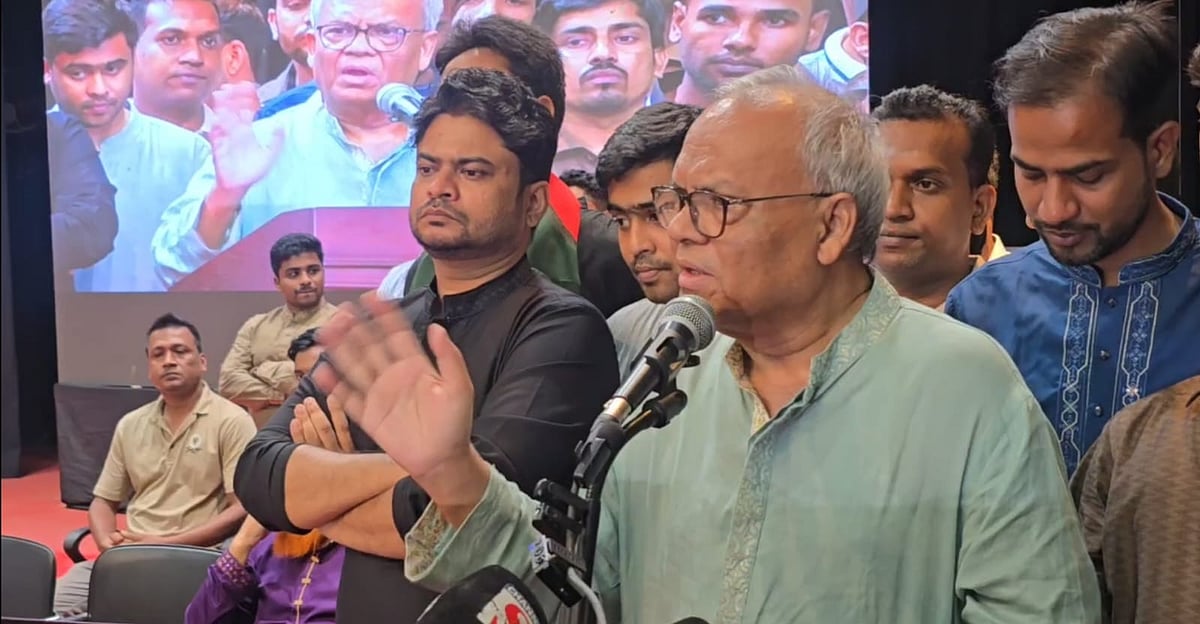
Ruhul Kabir Rizvi, Senior Joint Secretary General of the BNP and Political Advisor to the Prime Minister, stated that the language used by some young leaders today is detrimental to democracy, civilization, and a mature political culture, reflecting Prime Minister Sheikh Hasina's "uncivilized culture." He made these remarks on Sunday at a discussion meeting titled 'Bloody July: Remembrance and Resolve,' organized by the Rajshahi University unit of Chhatra Dal. Rizvi contended that while Sheikh Hasina engaged in frequent falsehoods and propaganda against political opponents, labeling them as fascists and murderers, she never resorted to indecent language. He asserted that politics driven by societal hatred is unsustainable and that Sheikh Hasina's defeat was a result of the united movement of students and the public. Rizvi urged new generation politicians to avoid past mistakes and foster a positive political culture. He also criticized the National Citizen Party (NCP) for forming an alliance with a politically regressive party, deeming it an incorrect decision from a philosophical standpoint. Rizvi emphasized that young politicians should adopt progressive and forward-thinking ideologies and enter politics with a commitment to contributing something new to the country. He recounted that Sheikh Hasina believed she could retain power through violence, even ordering shootings from helicopters, but failed to recognize the courage of the Bangladeshi people. Rizvi highlighted the July Revolution as a 17-year struggle for the restoration of democracy and the culmination of Begum Khaleda Zia's unwavering fight, noting that her firm stance on democracy could not be swayed by Hasina. Addressing political appointments in the administration, Rizvi acknowledged that governments worldwide, including the US 'spoils system,' often appoint their loyalists to key positions after a change in power, deeming it not illegal. However, he predicted that if Jamaat were to come to power in the future, it would lead to the most significant partisan appointments in the country's history. In a separate address, Chhatra Dal's General Secretary Nasir Uddin criticized Chhatrashibir for allegedly harassing women and engaging in cyberbullying in educational institutions for over two years, questioning their recent advocacy for a "female corner" at Dhaka University's TSC. He also criticized NCP leader Nasiruddin Patwari for his continuous derogatory remarks about politicians, suggesting he be sent back to his family for proper education before re-entering politics. Uddin also addressed Raksu's GS Salauddin Ammar, calling him mentally unbalanced and criticizing his use of a shovel to intimidate students, warning him of public retribution if such threats continued.
The discourse presented by BNP leader Ruhul Kabir Rizvi centers on a critique of contemporary political rhetoric, particularly among youth leaders, which he attributes to Prime Prime Minister Sheikh Hasina's influence. Rizvi frames this as a decline in political culture, contrasting it with past opposition strategies that, while critical, allegedly avoided personal indecency. The analysis of political language and its evolution is crucial for understanding public discourse and the health of democratic institutions. The BNP's perspective highlights a perceived shift towards more aggressive and potentially uncivil communication, which can polarize electorates and hinder constructive policy debate. The mention of historical events like the 'July Revolution' and comparisons to international practices like the US 'spoils system' suggest an attempt to contextualize current political actions within broader historical and global frameworks. However, the analysis of political appointments and accusations of partisan corruption, while common in political contestation, require careful scrutiny of evidence and governance mechanisms to ensure accountability and public trust. The criticism leveled by Chhatra Dal against Chhatrashibir and specific student leaders points to internal factional dynamics and ideological clashes within the student political landscape, underscoring the complex interplay of political competition and social issues in Bangladesh.
AI-generated to prompt reflection — not editorial opinion, not advice, not a statement of fact. How this works.