Bolsonaro's Son Accuses President Lula of Wanting New US Tariffs on Brazilian Goods
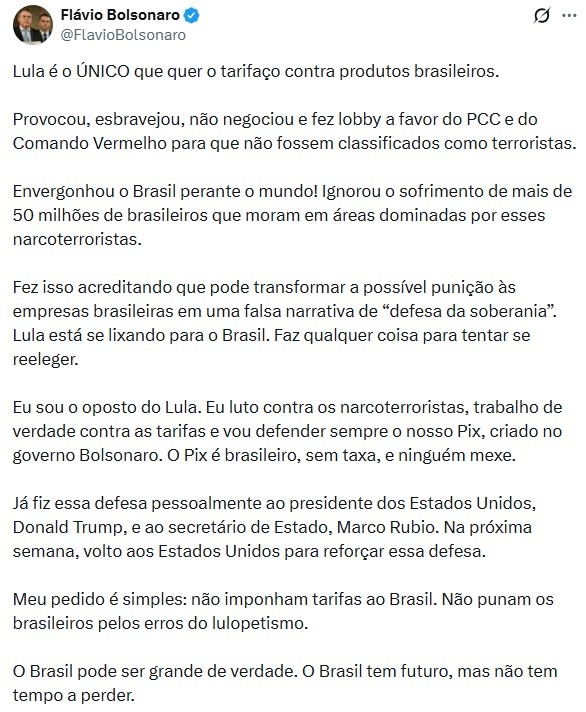
Senator Flávio Bolsonaro has responded to President Luiz Inácio Lula da Silva's accusation that the Bolsonaro family is responsible for a new tariff threat from the United States. Flávio Bolsonaro stated that President Lula is the "only one interested" in imposing new tariffs on Brazilian products. He further alleged that Lula "provoked, raged, did not negotiate, and lobbied in favor of the PCC (First Capital Command) and Comando Vermelho so that they would not be classified as terrorists." This statement was made on Flávio Bolsonaro's social media page. Earlier, on Thursday, November 2nd, President Lula declared that Brazil "is not for sale" and criticized Senator Flávio Bolsonaro's request to the Donald Trump administration to postpone the application of tariffs on Brazilian goods until after the October elections. Lula asserted on social media that there are no justifications for the US to impose new taxes on Brazilian exports, either before or after the presidential elections. This reaction from Lula followed a communication from Flávio Bolsonaro on Wednesday, November 1st, to the United States Trade Representative's Office (USTR). In this communication, Flávio Bolsonaro, a presidential pre-candidate for the PL party, argued that the imposition of a new 25% tariff could politically benefit Lula during an election year and requested a 180-day postponement of the measure. Lula countered that the potential for new tariffs originated from the Bolsonaro family's actions, calling Flávio's letter requesting a delay "another act by traitors to the homeland." He explicitly stated that the most absurd aspect is knowing that the origin of this situation was motivated by the Bolsonaro family itself, which publicly advocated for increased tariffs on Brazilian products.
This exchange highlights a political dispute over potential US trade tariffs and their domestic implications in Brazil. Senator Bolsonaro frames President Lula as the instigator of these tariffs, while President Lula positions the Bolsonaro family as the source of the threat, accusing them of acting against national interests. The core of the disagreement appears to be a strategic political maneuver regarding the timing and impact of US trade policy on the upcoming Brazilian elections. Both sides are leveraging the situation to gain political advantage, with accusations of betrayal and foreign influence being employed. The underlying economic mechanisms of trade negotiations and the potential consequences for Brazilian exporters remain central, but are currently overshadowed by partisan rhetoric. Future trade relations and Brazil's economic sovereignty will likely be shaped by how these domestic political dynamics interact with international trade policy decisions.
AI-generated to prompt reflection — not editorial opinion, not advice, not a statement of fact. How this works.