Bolsonaro's Son to Challenge President Lula in Brazil's Upcoming Election
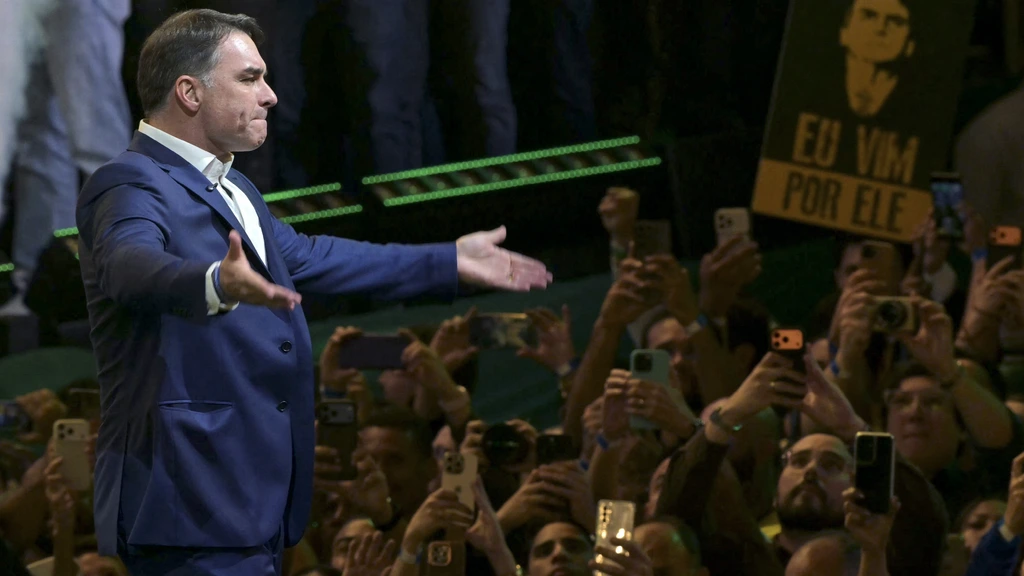
Flávio Bolsonaro, son of former Brazilian President Jair Bolsonaro, has been selected as the presidential candidate for the far-right Liberal Party, setting up a contest against incumbent left-wing President Lula da Silva in the October elections. The 45-year-old lawyer, who currently serves in the Brazilian Senate, was chosen at the party's congress. He received public support from Argentinian President Javier Milei, who traveled to Brazil for the event. Flávio Bolsonaro previously ran unsuccessfully for mayor of Rio de Janeiro in 2016. His father, Jair Bolsonaro, a former president from 2019 to 2022, was recently sentenced to 27 years in prison. His conviction stems from charges including plotting a coup following the 2022 election, which he narrowly lost to Lula da Silva. The aftermath of that election saw thousands of Bolsonaro supporters storming government buildings in Brasilia on January 8, 2023, resulting in significant damage and the arrest of at least 1500 individuals. Both Flávio and Jair Bolsonaro share political allies in figures like former U.S. President Donald Trump and Argentinian President Milei, who have previously characterized the legal proceedings against Jair Bolsonaro as a "witch hunt."
This electoral development pits a political scion against an established incumbent, reflecting a broader trend of dynastic politics and the enduring influence of populist movements. The legal challenges faced by the elder Bolsonaro and the January 8th events highlight the fragility of democratic institutions when confronted with deep societal divisions and challenges to electoral legitimacy. The endorsement from international figures like President Milei suggests a potential alignment of right-wing populist forces across South America, aiming to counter progressive governance. Future political stability in Brazil may hinge on the electorate's ability to reconcile historical grievances with the demands of contemporary governance, particularly in the context of evolving economic and social landscapes.
AI-generated to prompt reflection — not editorial opinion, not advice, not a statement of fact. How this works.