Book returned 150 years overdue to Australian library
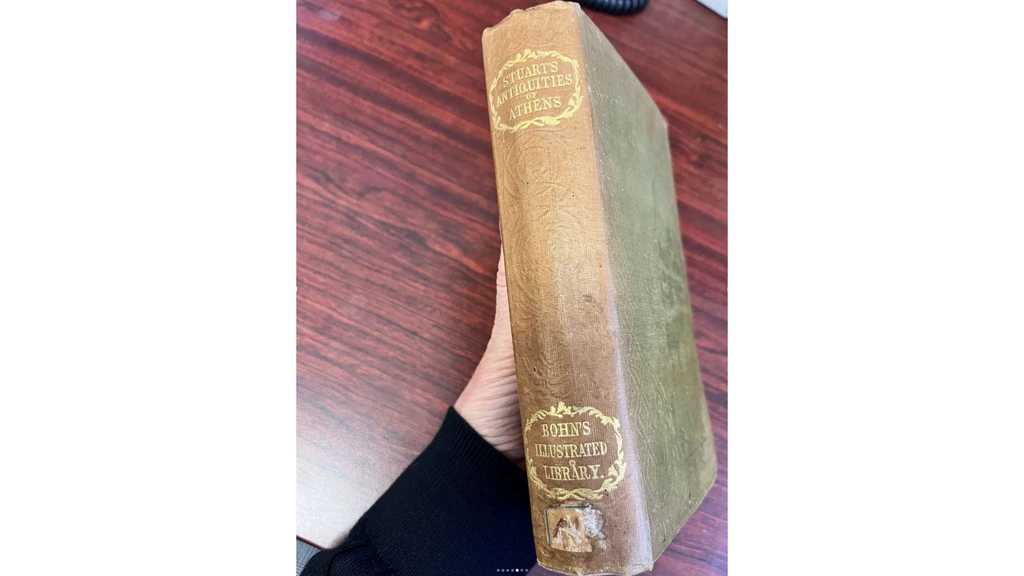
Library staff in the Australian coastal town of Kiama were surprised last week when a book was returned 150 years after its due date. Library manager Michelle Hudson stated she had never encountered such a situation. The man who returned the book, Ross Simmons, believes his great-grandfather may have borrowed it. Simmons discovered the book during renovations in his home, which was previously owned by his great-grandfather. He found the water-damaged book inside a teapot that had been bricked into a fireplace. Simmons expressed uncertainty as to why his ancestor, who also served as a councilor in Kiama, never returned the book. According to library rules at the time, a book had to be returned and any fines paid before another could be borrowed. Hudson suggested this might be why the book was never returned. The library could not verify if Simmons' great-grandfather had indeed borrowed the book, as lending records from the 1870s are lost. The book, 'Antiquities of Athens' from 1858, was the 506th item in the library's original collection, which opened in 1872. The overdue fine, adjusted for inflation, would amount to over 17,000 euros. Simmons was unconcerned about potential fines upon returning the book, and none were imposed. The library no longer charges overdue fines, though it humorously noted on Instagram that this fine could have helped with its financial issues. The library is now exhibiting the book, described as being in remarkably good condition, in its local history collection and will not be lending it out again.
This incident highlights the long-term consequences of record-keeping practices and the evolution of library policies. The discovery of a book returned 150 years late, with no verifiable borrowing history due to lost records from the 1870s, underscores the fragility of historical data. While the narrative focuses on a peculiar personal anecdote, it also implicitly raises questions about institutional memory and the value placed on physical artifacts over time. The library's decision not to impose a substantial inflation-adjusted fine, coupled with its current no-fine policy, reflects a modern approach to public access and engagement, prioritizing community service over punitive measures. This shift in policy, while practical for current operations, means that historical financial penalties, even if theoretically calculable, are no longer a relevant mechanism for managing library resources or ensuring accountability for past borrowing practices.
AI-generated to prompt reflection — not editorial opinion, not advice, not a statement of fact. How this works.