Brazil Poll: Lula Leads Flávio Bolsonaro in Second-Round Presidential Matchup
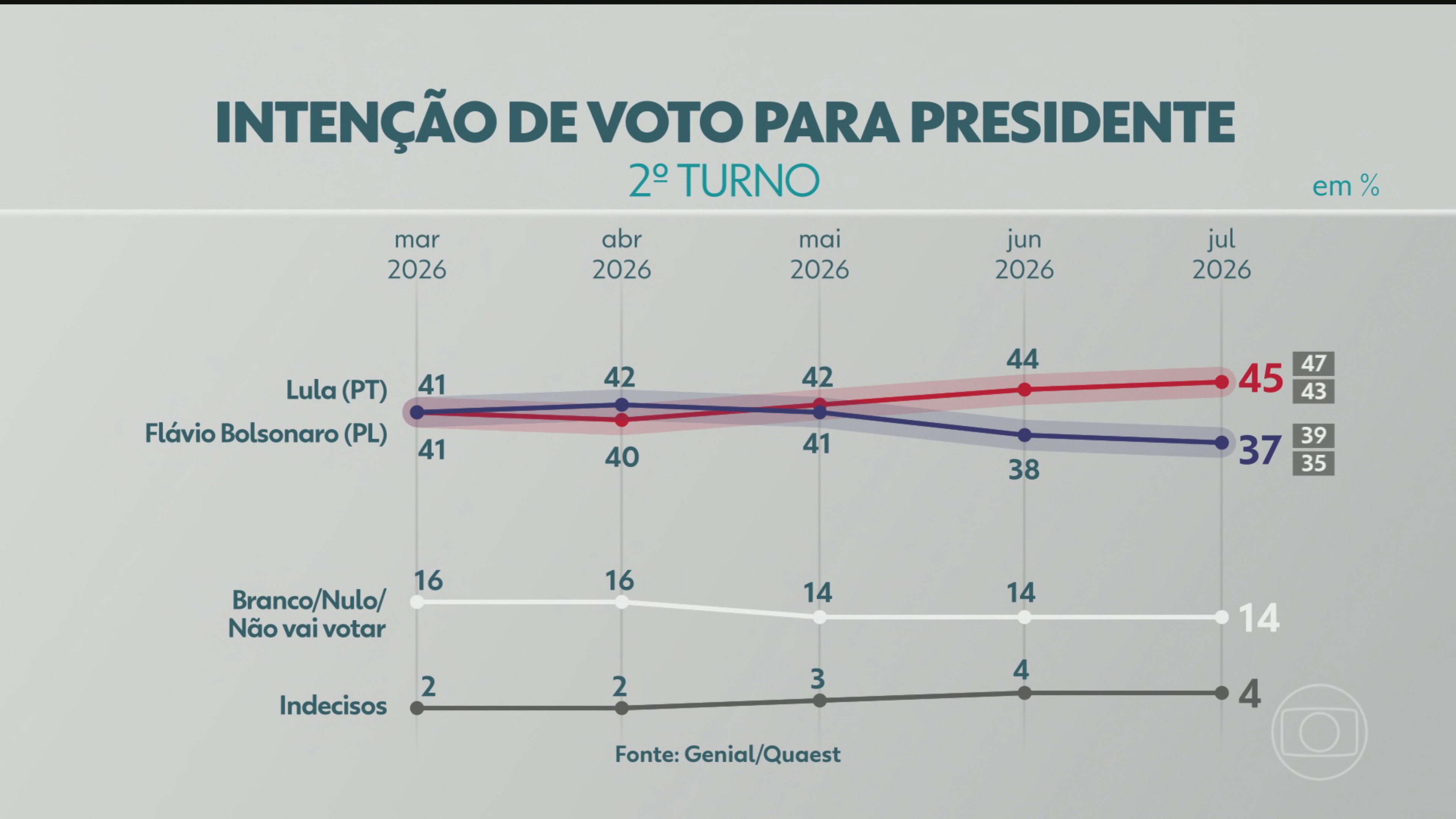
A new poll by Quaest indicates that Luiz Inácio Lula da Silva (PT) holds a lead over Flávio Bolsonaro (PL) in a hypothetical second-round presidential election, with 45% of the vote compared to Bolsonaro's 37%. The survey, conducted between July 10th and 13th among 2,004 individuals across 120 cities, has a margin of error of two percentage points and a 95% confidence level. Lula's support in this second-round scenario has increased from 41% in March to the current 45%, while Bolsonaro's has decreased from 41% in March to 37%.
In the first-round intention of vote, Lula is polling at 40%, a slight increase from previous months, with a potential range of 38% to 42%. Flávio Bolsonaro is at 28%, a decrease from 32% in March, with a range of 26% to 30%. Other candidates like Ronaldo Caiado (PSD), Renan Santos (Missão), and Romeu Zema (Novo) are polling at 4%, 3%, and 2% respectively, with Caiado, Zema, and Santos within the margin of error of each other. The undecided voters now stand at 11%, while those who will vote blank, null, or not at all represent 8% of respondents.
The poll also assessed the approval of President Lula's government, with 48% approving and 47% disapproving. This represents a slight increase in approval from March (44%) and a decrease in disapproval from 51%. When asked for a general evaluation of the government, 36% rated it positively, 36% negatively, and 25% as regular. The survey also explored second-round scenarios involving Lula against Ronaldo Caiado, Romeu Zema, and Renan Santos, with Lula leading in all tested matchups.
This poll data reflects evolving voter sentiment and candidate positioning within Brazil's political landscape. The slight upward trend in Lula's favorability, both in first-round intentions and second-round matchups, alongside a marginal increase in government approval, suggests a potential consolidation of support. Conversely, Flávio Bolsonaro's reported decline in second-round scenarios warrants examination of campaign strategies and voter outreach. The significant percentage of undecided and blank/null votes indicates a segment of the electorate remains uncommitted, presenting opportunities for campaign shifts. Future electoral dynamics will likely be influenced by economic perceptions and the effectiveness of each campaign in mobilizing their respective bases and attracting swing voters, particularly as the election approaches.
AI-generated to prompt reflection — not editorial opinion, not advice, not a statement of fact. How this works.