Brazil's Electorate Grows to 158.7 Million for 2026 Elections
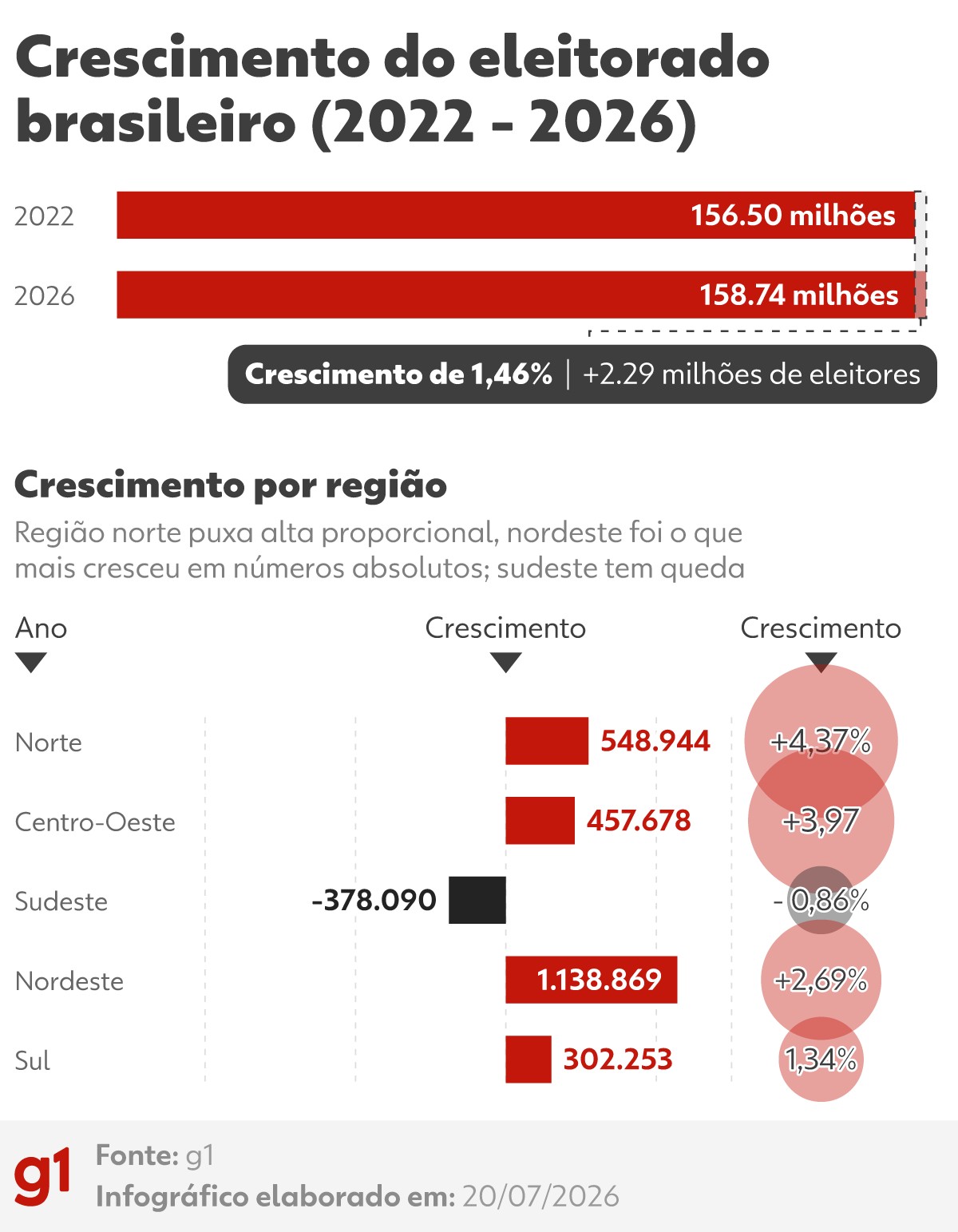
Brazil's Superior Electoral Court (TSE) announced that the country's electorate has expanded to 158.7 million eligible voters for the 2026 general elections. This represents a 1.46% increase, or 2.29 million more voters, compared to the 156.4 million registered in the 2022 general elections. The first round of voting is scheduled for October 4, with the second round on October 25. Voters will elect the President, 27 governors, 54 senators, and numerous federal, state, and district deputies. Regionally, the North saw the largest proportional growth with a 4.4% increase, adding 549,000 voters for a total of 13.1 million. The Center-West followed with a 3.97% rise, reaching nearly 12 million voters. Conversely, the Southeast, the most populous region, experienced a slight decrease of 0.56%, with its electorate shrinking from 66.7 million to 66.3 million. The number of Brazilians registered to vote abroad also surged by 31.82%, adding 221,798 voters to reach 918,876. The Northeast recorded the largest absolute increase, gaining 1.1 million voters to total 43.5 million. In terms of gender, women constitute the majority of the electorate at 52.84% (83.8 million), an increase of 1.83%, while the male electorate grew by 1.08% to 74.8 million. Data on race and color, collected through self-declaration since 2024, shows that 20.62% of voters made a declaration, with the largest group identifying as 'parda' (mixed-race), followed by 'branca' (white) and 'preta' (black).
The growth in Brazil's electorate, particularly the significant increase in voters abroad and in specific regions like the North and Northeast, reflects demographic shifts and potentially increased political engagement. The slight contraction in the Southeast and São Paulo's reduced proportional share suggest a decentralization trend in electoral weight, which could influence campaign strategies and resource allocation. The growing female electorate, outpacing male growth, highlights evolving societal demographics and their impact on political representation. The TSE's efforts to gather more detailed self-declared demographic data, though currently limited in scope, are a step towards more nuanced electoral analysis, crucial for understanding representation in an increasingly diverse society. Future electoral dynamics may be shaped by these regional and demographic trends, alongside evolving voter participation patterns and the implications of mandatory voting laws.
AI-generated to prompt reflection — not editorial opinion, not advice, not a statement of fact. How this works.