Brazil's Flávio Bolsonaro to Argue Against US Tariffs in Washington Hearing
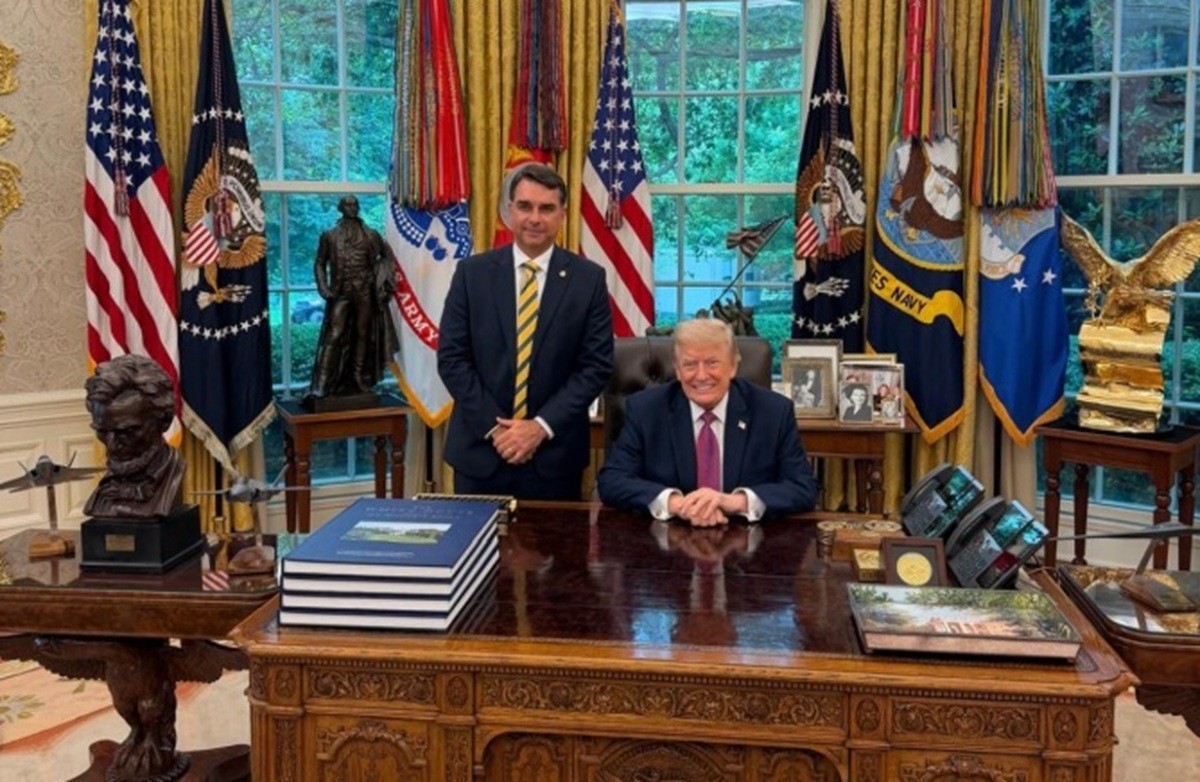
Senator Flávio Bolsonaro, also a presidential pre-candidate, will attend a public hearing hosted by the U.S. Trade Representative's Office (USTR) in Washington D.C. on Tuesday, July 7th. The hearing focuses on proposed tariffs by the Donald Trump administration on Brazilian products. Bolsonaro plans to voice opposition to the 25% tariff on Brazilian goods and any measures related to Brazil's PIX payment system. He arrived in the U.S. capital on Sunday, July 5th. Bolsonaro has been independently engaging in international affairs, separate from Brazil's Ministry of Foreign Affairs (Itamaraty), and has been in contact with representatives of the Trump administration. He argues that the proposed tariffs would negatively impact U.S. investments in Brazil and politically benefit the current Brazilian government during an election year. He also suggested that the U.S. postpone the tariffs for 180 days and implement them only after the elections, stating that previous tariffs did not alter Brazilian authorities' behavior. Other participants include Ambassador Roberto Azevedo representing the National Confederation of Industry (CNI) and Letícia Sperb Masselli from the Brazilian Footwear Industries Association (Abicalçados). In a prior submission to the USTR, Bolsonaro stated that PIX does not replace credit cards and suggested it not be connected to non-Western systems. The Brazilian government will send observers to the hearing, believing that technical, high-level discussions are more appropriate for negotiation than public forums. These discussions are ongoing, with a deadline of July 15th for a potential agreement. The USTR investigation, based on Section 301 of the Trade Act of 1974, cited concerns about PIX, digital platform regulation, trade agreements, deforestation, intellectual property, and anti-corruption policies. A separate U.S. investigation into goods produced with forced labor also proposed an additional 12.5% surcharge, potentially bringing the total to 37.5% on some exports, though strategic products like coffee, meat, and aircraft may be exempted.
This event highlights the complex interplay between international trade policy, domestic political considerations, and national sovereignty claims. The U.S. administration's proposed tariffs, framed as a response to perceived trade barriers and regulatory issues in Brazil, are met with arguments that they could be counterproductive, potentially bolstering the incumbent Brazilian government's political standing during an election year. The involvement of a presidential pre-candidate in advocating against these measures suggests a strategic effort to leverage international economic policy for domestic political gain. The Brazilian government's approach, prioritizing behind-the-scenes technical negotiations over public pronouncements, reflects a pragmatic strategy to manage the immediate economic fallout while navigating diplomatic channels. Looking ahead, the tension between U.S. trade enforcement mechanisms and Brazil's regulatory autonomy underscores the ongoing challenge of aligning diverse national interests within a globalized economic system, particularly as digital payment systems and environmental policies become increasingly central to trade relations.
AI-generated to prompt reflection — not editorial opinion, not advice, not a statement of fact. How this works.