Brazil's South Braces for Potential "Bomb Cyclone" Formation
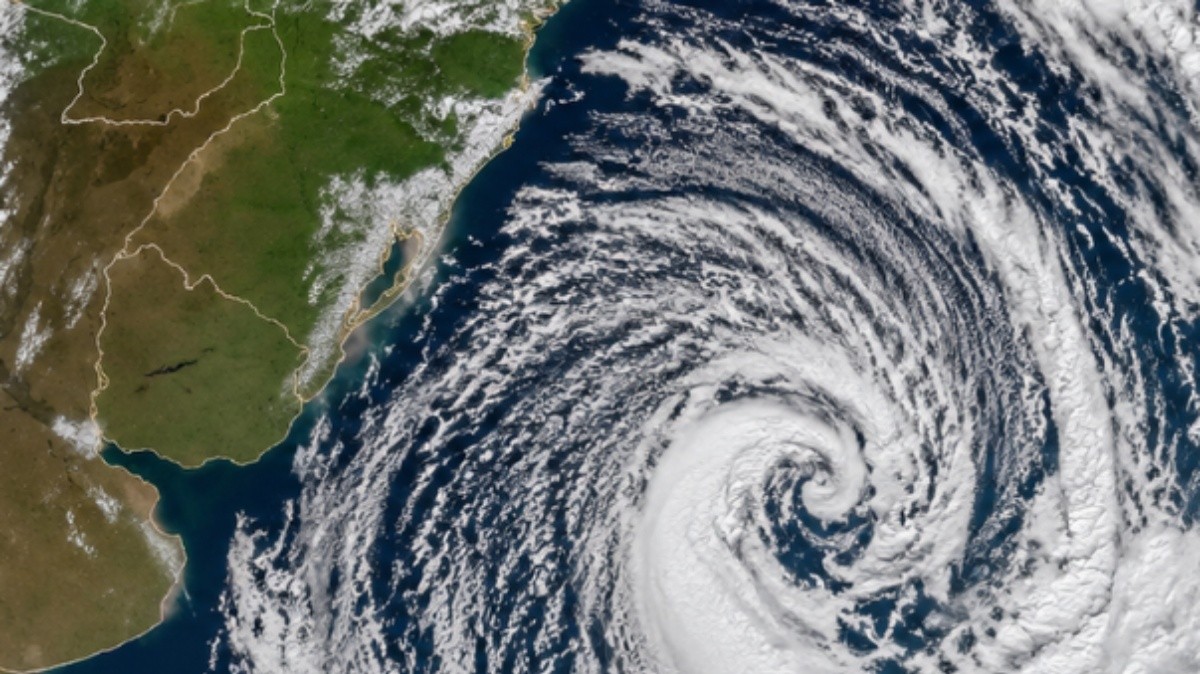
Brazil's National Institute of Meteorology (Inmet) is closely monitoring the potential formation of a powerful extratropical cyclone over the region encompassing Argentina, Uruguay, Southern Brazil, and the Atlantic Ocean. Inmet forecasts conditions conducive to rapid intensification, a phenomenon known as explosive cyclogenesis or a "bomb cyclone," which could occur between Thursday, June 6, and Saturday, June 8. This process is characterized by a swift drop in atmospheric pressure, leading to severe weather conditions including strong winds, intense rain, and abrupt temperature shifts. The system is expected to organize over northern Argentina and Paraguay on Thursday before moving towards Uruguay and the coast of Rio Grande do Sul. If the predicted rapid intensification occurs, the cyclone could bring significant impacts to Brazil's Southern Region, with strong gusts potentially exceeding 100 km/h over the Atlantic Ocean. Associated weather fronts may cause heavy rain, lightning, hail, and wind squalls, with winds over 60 km/h expected in Rio Grande do Sul and Santa Catarina. Following the cyclone's passage offshore, a cold air mass is anticipated to move into the Center-South of the country, causing a sharp temperature decrease that could also affect the Center-West and Southeast regions. Inmet has issued warnings for potential storms, with alerts escalating to orange (danger) for Rio Grande do Sul and parts of Santa Catarina, Paraná, and Mato Grosso do Sul on Thursday. The trajectory and intensity of the system remain subject to updates.
The potential development of a "bomb cyclone" highlights the increasing frequency and intensity of extreme weather events driven by climate shifts. Meteorologists are tasked with providing accurate forecasts to enable public safety measures, balancing the need for timely warnings with the inherent uncertainty in predicting complex atmospheric dynamics. The economic and social implications of such events, from infrastructure damage to agricultural disruption, underscore the importance of robust climate adaptation strategies and resilient infrastructure planning. As these phenomena become more common, understanding the interplay between oceanic and atmospheric conditions, and their amplification by global warming, will be critical for future preparedness and mitigation efforts.
AI-generated to prompt reflection — not editorial opinion, not advice, not a statement of fact. How this works.
